


At a glance
Tree & Shrub Compost
A new home for a woody plant starts below the surface. This ready-to-use growing medium is labelled for trees and shrubs in containers and garden ground. The 10-litre bag contains peat, perlite, raw clay and an initial nutrient supply.
- Use
- Containers & ground
For planting trees and shrubs.
- Bag contents
- 10 litres
Ready to use with nutrients added.
- Base
- Peat, perlite & raw clay
With calcium carbonate, NPK(Mg) fertiliser and wetting agents.
- Review further feeding
- After about 4–6 weeks
Check nutrient levels and add feed if needed.
The label, plant species and growing site determine use.
A shared compost does not replace soil assessment or species-specific care.
Easy application
A new home for a woody plant starts below the surface. This ready-to-use growing medium is labelled for trees and shrubs in containers and garden ground. The 10-litre bag contains peat, perlite, raw clay and an initial nutrient supply.
- Check the root ball and space
Choose root space, container or planting site for the species and size of the woody plant.
- Keep the planting depth
Position the root ball gently and fill around it with compost. Keep the stem base clear.
- Water and follow establishment
Water thoroughly, check drainage and monitor moisture during the following weeks.
After about four to six weeks, check nutrient levels and begin supplementary feeding if needed. Existing nutrients already count towards the supply; follow the chosen fertiliser for subsequent doses.
Read the complete planting guideProduct information
Application & repottingFor trees and shrubs in containers and garden ground.
For planting trees and shrubs in containers and garden ground. Species, root system, soil and position determine how the compost is used. The illustrated guide explains repotting an already rooted woody plant.
After about four to six weeks, check nutrient levels and begin supplementary feeding if needed. Existing nutrients already count towards the supply; follow the chosen fertiliser for subsequent doses.
PropertiesProduct characteristics and guidance
The original label lists 65% organic soil material from raised-bog peat H2–H5, perlite of natural origin, clay (raw clay), calcium carbonate and NPK(Mg) fertiliser.
Wetting agents aid water uptake. This product contains peat. The peat input percentage is distinct from the separately declared organic matter content.
Declared growing-medium valuesOrganic matter, pH, salt content and available nutrients.
Nutrient figures refer to the time the manufacturer places the product on the market. Levels may fluctuate or change in storage; check before using stored compost.
- Organic matter: 30%.
- pH (CaCl₂): 5.8.
- Salt content (KCl): 2.2 g/l.
- Nitrogen (N): 220 mg/l (CaCl₂).
- Phosphate (P₂O₅): 270 mg/l (CAL).
- Potassium oxide (K₂O): 400 mg/l (CAL).
- Magnesium (Mg): 70 mg/l (CaCl₂).
Pairs well with
Selected additions for your plant care.
-

Maple Fertiliser
From €9,85 View productMaple Fertiliser for subsequent feeding of Japanese maples. For other woody plants, choose an appropriate fertiliser and account for nutrients already in the compost.
-

Fig Fertiliser
From €9,85 View productFor common figs (Ficus carica) when extra nutrients are needed. Account for the compost’s initial fertiliser and check need and active growth before feeding.
-

Conifer Fertiliser
From €9,85 View productConifer Fertiliser for conifers during growth. Account for the compost's existing nutrients and assess further feeding needs as directed on the compost label.
-

Photinia Fertiliser
From €9,85 View productPhotinia fertiliser for additional nutrition during active growth. Account for the compost's initial fertiliser before feeding later.
-

Redwood & Sequoia Fertiliser
From €9,95 View productRedwood fertiliser for subsequent feeding as needed. For young trees, account for the reduced label dilution and initial nutrients in the compost.
-

Wisteria & Laburnum Fertiliser
From €9,95 View productTree and shrub compost for the root space of both woody plants; account for position, drainage and initial fertiliser.
-

Yew Fertiliser
From €9,85 View productTree and shrub compost for yews in suitable containers or at planting; maintain drainage and account for initial fertiliser.
-

Tree & Shrub Fertiliser
From €9,95 View productMatching fertiliser for subsequent feeding during growth. Account for the compost's initial nutrients and follow plant needs and the fertiliser label.
-

Supreme Hedge Fertiliser
From €11,95 View productFor later feeding: allow for nutrients already in the compost and follow the fertiliser’s own label.
-

Ivy & Euonymus Fertiliser
From €9,95 View productFor later feeding: allow for nutrients already in the compost and follow the fertiliser’s own label.
-

Flowering Shrub Fertiliser
From €9,85 View productFor later feeding: allow for nutrients already in the compost and follow the fertiliser’s own label.
-

Flowering Tree Fertiliser
From €9,85 View productFor later feeding of suitable flowering trees. Account for the species’ soil requirements and the compost’s initial nutrients; follow need and the fertiliser label.


GREEN24 · Product knowledge
Understanding Tree & Shrub Compost
Make room for roots
Woody plants shape a garden
Trees and shrubs bring together shade, flowers and foliage. Suitable soil and enough root space belong in the plan for every planting position.
Details & background
A new home for a woody plant starts below the surface. This ready-to-use growing medium is labelled for trees and shrubs in containers and garden ground. The 10-litre bag contains peat, perlite, raw clay and an initial nutrient supply.
Maples are one example within this broader group. Site, moisture and eventual plant size still matter when selecting a pot or planting place.
Growing medium & root space
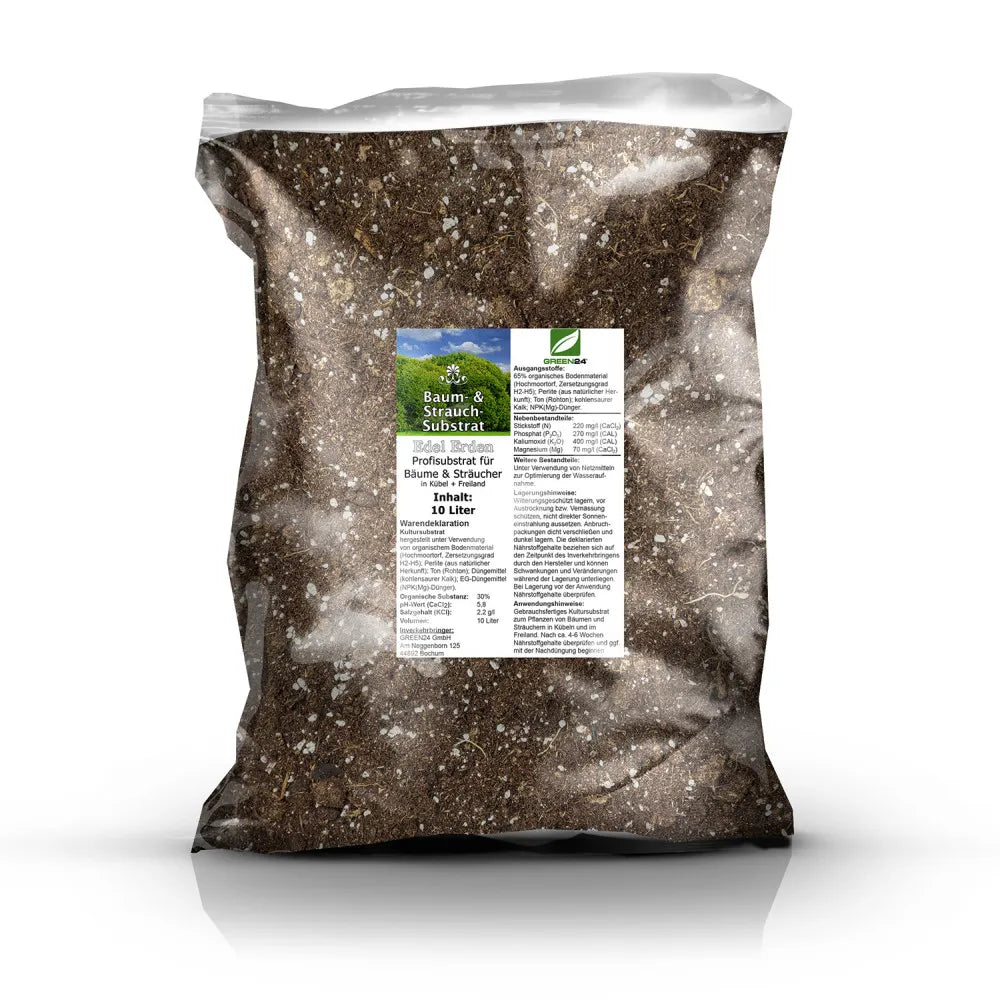
Ready to use with its own declaration
The original bag contains 10 litres of Tree and Shrub growing medium. All inputs and nutrient values appear in the product information.
Details & background
The root ball and fresh compost can hold different amounts of water. Check both while the plant establishes. Clear drainage and thoughtful watering remain necessary with any growing medium.
The product information collects all declared ingredients and values. The bag photograph shows this product itself; the other images illustrate woody plants and container culture.
Repotting: the complete process
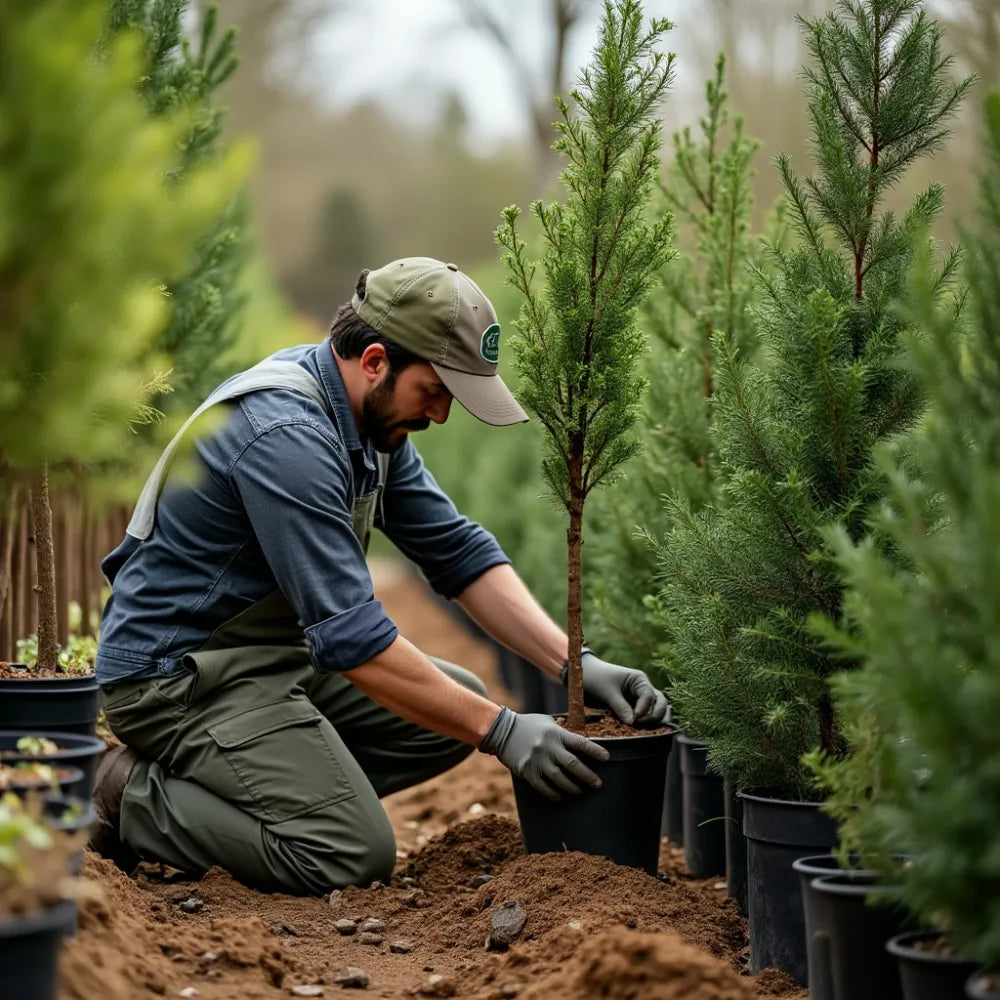
Support the root ball and prepare its space
Handle the woody plant gently when changing containers. The steps below explain planting depth, filling and aftercare in a pot.
These eight illustrated steps describe the container change of a rooted tree or shrub. For planting in garden ground, assess the existing soil and site separately.
-
Recognise the need to repot
Check whether roots fill the pot densely or the compost has lost its structure. Repotting should improve root space rather than simply follow an annual date.
Plan substantial work in suitable weather towards the start of growth. Choose timing especially carefully for newly leafed Japanese maples or unhealthy plants.
-
Choose a pot for the root ball and growth
A stable container needs room for the ball and some fresh compost. The plant’s shape and eventual size also influence the choice.
The existing ball already occupies volume. Calculate new compost for the free space beside and beneath it, not automatically the entire pot volume.
-
Check drainage
Inspect drainage holes and clear any blockage. A planting pot inside a closed decorative container needs its own open outlet.
A coarse layer in the illustrations does not replace drainage holes. It must not obstruct the flow and is not necessary in every pot.
-
Release the old pot gently
Support the weight at the root ball. Loosen the container by gently pressing or tapping it; do not pull the plant out by slender branches.
Preserve healthy roots and remove loose old compost. Assess strongly circling or damaged roots separately; heavy root pruning is not an automatic repotting step.
-
Retain the original planting depth
Add some compost and position the root ball. Keep its surface at the previous depth, with space for watering below the rim.
Do not heap compost around the stem base or an existing graft union. Check that the plant sits upright and stable.
-
Fill around and firm lightly
Add compost to gaps around the ball in small portions. Gentle pressure closes larger air spaces.
Do not compact the compost hard. Watch planting depth, stability and even watering space around the rim.
-
Water the new root zone
Water slowly and evenly so that the fresh compost beside the ball is moistened too. Observe drainage from the base.
Match the quantity to existing moisture. Afterwards, remove standing water from the saucer or outer container; the pot should not remain in it.
-
Follow establishment and nutrient supply
During the following weeks, check moisture in both the old ball and new compost. For Japanese maples, a suitable position and even moisture protect delicate foliage.
Record the repotting date: after about four to six weeks, the label calls for nutrient checks and supplementary feeding if needed. Do not feed dormant plants simply by the calendar.
Japanese maple in the plant catalogue Application and later feeding
Follow the new root space
Keep moisture in balance
Check before watering instead of using a fixed amount every day. A small root ball surrounded by new compost can need particular attention.
Provide species-specific conditions
Japanese maples often need shelter from drying wind and strong midday sun. Other trees or shrubs may prefer different conditions.
Account for existing nutrients
The label calls for checking nutrient levels after about four to six weeks. Select subsequent fertiliser for the actual plant; the linked Maple Fertiliser is for Japanese maples.
Deciduous Trees & Shrubs in the plant library
For container growing and suitable planting sites: provide a well-drained root environment. Account for starter nutrients before further feeding as needed. Ornamental Cherry Fertiliser: For subsequent feeding of ornamental cherries during growth. Account for starter nutrients in the compost; follow plant needs and the fertiliser’s own instructions. Weeping Willow Fertiliser: For subsequent feeding of weeping and dappled willows during growth. Distinguish the willow species in their care and account for starter nutrients in the compost. Strawberry Tree Fertiliser: A humus-rich base with good drainage for container-grown strawberry trees (Arbutus unedo). Account for starter nutrients and feed later only according to plant need and the fertiliser’s own instructions.
A growing-medium base for container-grown che trees. Provide sufficient root space and drainage; account for the compost’s starter nutrients before additional feeding.
Tree and shrub compost can serve as a humus-rich base for cinnamon in a warm, frost-protected container. Ensure effective drainage and account for existing starter nutrients.
For later feeding: Redbud Fertiliser.
For later feeding: Dove Tree Fertiliser.
For later feeding: Paperbush Fertiliser.
For later feeding: Tetrapanax Fertiliser.
Assess changes before adding products
Wilting foliage, leaf scorch and weak growth can have different causes. Check the roots, soil moisture, drainage and recent weather. Photographs and details of previous care help when the cause is unclear.
Questions about Tree & Shrub Compost
Which woody plants is this compost intended for?
The label names trees and shrubs in containers and garden ground. The manufacturer’s page gives maple as one example. The particular species’ soil and nutrient requirements still need consideration.
What matters particularly for Japanese maples?
Shelter from drying wind and even root-ball moisture help protect delicate leaves. Consider cultivar, root space and existing nutrients when planning care. Do not automatically add fertiliser immediately after repotting.
Does the mix contain peat?
Yes. The original label lists raised-bog peat H2–H5 as an input. Other ingredients and the complete measured values are in the product information.
When should supplementary feeding begin?
After about four to six weeks, check nutrient levels and feed further if needed. Fertiliser is already included; do not automatically add more immediately after repotting.
Can I use it when planting in garden ground?
Yes, the declaration includes containers and garden ground. Assess existing soil structure and the root system. No universal mixing ratio with garden soil is specified, and filling every planting hole entirely with compost is not recommended.
Is it also a bonsai mix?
A shallow bonsai pot has particular requirements for particle size, moisture and root care. This general woody-plant compost is not automatically the one correct mix for every bonsai. That culture has a separate product range.
Explore individual woody plants
Japanese maple as a care example
The Acer palmatum profile explains leaves, growth, pruning and care through the seasons. It does not represent every species in the maple genus.
View the Japanese maple profile Common fig: position, fruit & care → Conifers: species and care → Photinia: new growth, position & pruning → Redwoods: distinguish species and plan their growing space Wisteria: care & position Laburnum · Golden Chain Tree: care & position Yews · Taxus: care & position Hedge Plants English Ivy · Hedera helix Evergreen Euonymus · Wintercreeper Flowering Shrubs
Safety and storage
Safety instructions
Wash your face and hands thoroughly. Use diluted fertiliser promptly and keep it out of water bodies and wastewater.
Product GPSR safety information
A safety PDF is not currently available for this product. Please refer to the product information below and the label.
Storage
Please follow the product-specific information on the label and in the full description.
Read the full product description →Manufacturer / company placing the product on the market
GREEN24 GmbH
Am Neggenborn 125
44892 Bochum, Germany
info@green24.de
www.green24.de