

Water-soluble & available
All nutrients are water-soluble. In the fully diluted mixture, they are available for feeding through roots and leaves.


Start simply · explore when you want
Parlour palm, kentia or windmill palm: species determines light, warmth and growth. Combine suitable nutrition with practical knowledge for indoors, conservatories and containers.
For tropical and subtropical palms. Choose indoors, conservatory or container growing according to species; palm-like plants are not automatically true palms.
April–September is the regular period; tropical species follow their actual growing phase. Pause feeding during a growth pause.
After repotting, account for existing fertiliser and handle the root ball gently. Check moisture and drainage before feeding.
Application in one place
Choose the water volume or use your palm’s height and width as a rough watering guide. The calculator uses the confirmed standard dilution; young plants and seedlings have their own settings.
Base dilution: 5 ml per 1.5–2.5 l of water. The calculator uses the confirmed standard dilution of 5 ml per 1.5 l. For young plants or seedlings, the selected setting reduces the concentrate amount.
1 capful = 5 ml. Use a suitable measuring aid for smaller partial amounts.
Enter a water amount from 0.1 to 1,000 litres.
A rough guide for watering the roots of one palm, not for spraying or hydroponics. Measure height from the growing-medium surface and the width of the crown, not just stem length. Root-ball moisture, pot volume, rooting, light and temperature also matter. Use only when watering is needed; do not cause standing water or force the whole guide volume into the pot.
General GREEN24 guide: height (m) × width (m) × 3–4 litres. Centimetres are converted to metres. Concentrate quantity follows this fertiliser’s confirmed standard rate and the selected setting. The guide does not measure the individual water needs of your palm species.
Use a clean watering can or sprayer; preferably low-lime water or rainwater at 15–25 °C.
Choose the water volume and dilution setting. The standard dilution and original range are shown beside the calculator; plant size does not select the setting automatically.
Start by filling the container with part of the chosen water volume.
Shake the bottle. 1 capful = 5 ml; use a measuring aid for smaller partial amounts.
Add the calculated amount of concentrate to the water.
Top up to the chosen water volume and mix well. Watering or spraying: see below.
When to feed? Feed during growth; repeat according to your palm’s development, without a fixed weekly interval. The regular period is April–September; tropical species follow their growth periods. Account for pre-fertilisation and earlier feeds.
Moisten the root ball first and distribute the fully diluted mixture evenly over the growing medium. Allow excess water to drain. Check below the surface; water collects around roots in an undrained outer pot.
If the species, leaf surface and growing conditions suit foliar feeding, lightly wet the fronds in the morning, evening or overcast conditions. Avoid open flowers. Root and foliar feeds belong to the same nutrient supply.
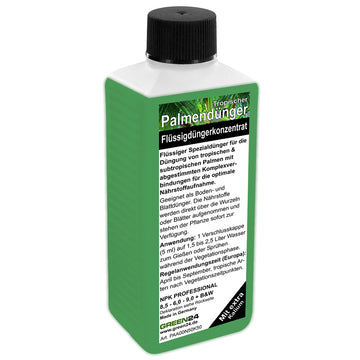
Liquid NPK concentrate for tropical and subtropical palms, with declared trace nutrients. For root and foliar feeding after dilution with water. The dosage range supports use according to the label; feeding follows the growing period of the particular palm species.
Net mass: 304 g for 250 ml; 1215 g for 1 litre.
The dilution is the same for both pack sizes.
| Pack size | Price |
|---|---|
| 250 ml | €9,95 EUR |
| 500 ml – twin pack (2 × 250 ml) | €18,95 EUR |
| 1 litre | €29,95 EUR |
Declared nutrient percentages. Product pH: 6.8.
Pre-fertilised soil and fertiliser already in the root ball contribute to the nutrient supply. Each of the four care products listed below can be mixed with our liquid fertiliser. When applying them together, follow both products’ specific instructions; conflicting or stricter directions take precedence. Do not mix undiluted concentrates.
Our liquid Palm Fertiliser can be mixed individually with Schädlings-Frei Organic, Trauermückenfrei Organic, KIRON Milben-Ex or Rosen Pilz-Frei BOCCACIO. This confirmation applies to the fertiliser paired with one of these products at a time. Follow specific application instructions and the stricter conditions of both products.
Request the compatibility table →Beyond NPK · understand the formulation
Water-soluble nutrients and the formulation support straightforward feeding for your palm. Discover the properties of the finished watering or spraying solution.
All nutrients are water-soluble. In the fully diluted mixture, they are available for feeding through roots and leaves.
Copper, iron, manganese and zinc are declared as EDTA chelates. This binding helps keep these trace nutrients available in solution.
The buffer system helps regulate the pH of the finished watering or spraying solution. The source water also influences the resulting value.
Good wetting and adherence help distribute the spray solution across the leaves. Dissolved nutrients are then available at the leaf surface for uptake.
The formulation helps reduce adverse hard-water effects and deposits on the leaves. Low-lime water or rainwater provides a good starting point.
At a suitable dilution, high plant tolerance supports the development of new fronds. Appropriate nutrition supports your palm’s natural foliage.
Suitable nutrition supports leaf development and green foliage. Leaf finish means an even, well-kept appearance, not a sprayed-on gloss film. The rate of new frond development also depends on species, light, warmth and roots. Feed during actual growth.
Chelation binds metal ions and can reduce adverse hard-water effects; it does not remove calcium or magnesium from the water. The product pH of 6.8 describes the concentrate. The finished mixture’s pH also depends on the source water; no fixed target value is promised.
Use clean, suitable watering or spraying equipment. Measure the water and calculated concentrate quantity carefully.


Green fronds. A special place.
A narrow spear at the centre of the crown gradually opens into a new frond. Fans or fine leaflets bring light and shade to life, revealing the development of your palm.
A suitable nutrient supply belongs in your palm-care routine alongside light and a healthy root zone. A measured water volume and the calculator make the concentrate easy to include in your care.
Each palm species has its own habit: broad fans, slender leaflets or gracefully arching fronds. Suitable light and space allow that natural form to stand out.
New fronds develop at the growing point of each stem. Watch the central spear open and retain living fronds on the plant.
In a pot, water, air and root space must work together. Check moisture below the surface and allow excess water to drain.
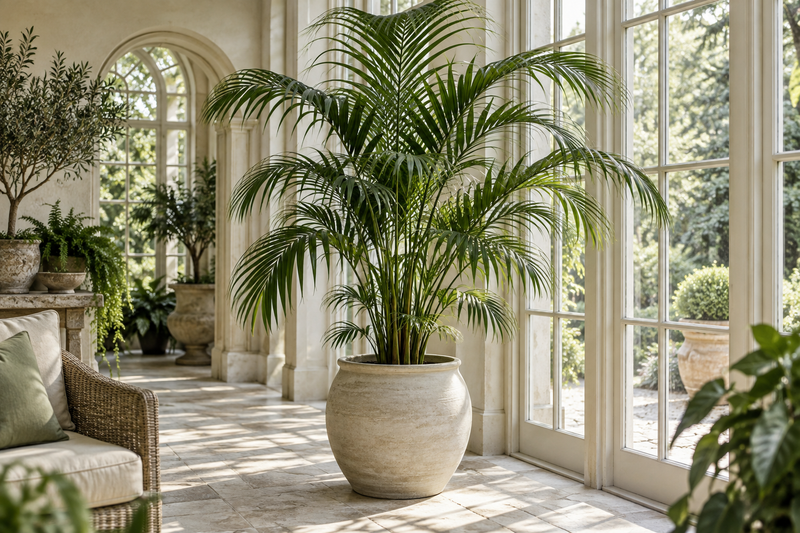
A kentia in a bright room needs different care from a windmill palm in a garden. Choose position and winter care by species; the plant profile helps you compare them.
From root ball to growing point
Fronds use light to make sugars. Roots supply water and mineral nutrients. Transport tissues in the stem link these areas with the growing point, where new fronds develop. Nutrition and growth work together.
Roots need water as well as air in the growing medium. A well-rooted, freely draining root ball provides both. Handle roots gently when repotting, retain the previous planting depth and account for fertiliser in the new compost.
Green fronds provide the basis for further growth through photosynthesis. Nitrogen contributes to chlorophyll and protein formation. More fertiliser alone will not correct slow growth in a dark position. Retain living fronds.
The central spear is the new leaf. Do not shorten the stem or cut off its growing point: that stem will not replace it with ordinary side shoots. Clumping species have several stems; several seedlings in one pot are not branches of one plant.
Nitrogen supports chlorophyll and proteins in green fronds. Phosphorus contributes to energy transfer; potassium supports water regulation and transport. Declared trace nutrients complement the supply. No magnesium content is declared for this fertiliser; investigate unusual fronds rather than assuming a deficiency this product will cure.
Understanding plant feeding
From the root ball or frond surface into living tissues: explore the uptake routes. Choose the application to suit your palm species and its growing conditions.
Select a point in the picture or choose a stage.
Stage 01 / 04
The mixture reaches the growing medium around the palm’s roots. Dissolved nutrients are available at the interface between moist medium and absorbing root surfaces.
Good to knowAlways dilute the concentrate and keep to the stated dosage.
Watering carries dissolved nutrients into the growing medium around the roots. Contact with the absorbing root surfaces is the first step.
Stage 02 / 04
Fine root hairs increase contact with the growing medium. Tiny transport proteins in the membranes surrounding root cells help dissolved nutrients enter the cells.
Good to knowRoots take up nutrients; they do not simply absorb all the fertiliser along with the water.
Root hairs increase the contact area. Transport proteins in cell membranes enable mineral ions to enter; water movement and nutrient uptake are distinct processes.
Stage 03 / 04
In your palm's roots, cell membranes and their transport proteins regulate the uptake of dissolved nutrients. Substances do not simply flow unfiltered into the plant with the irrigation water.
Good to knowMore fertiliser does not automatically mean better nutrition.
Between contact with the root surface and onward transport, controlled processes take place within the root tissues. Transport across cell membranes helps the palm take up nutrients; water movement and nutrient uptake are distinct processes.
Stage 04 / 04
Inside the roots are transport tissues called xylem. Water and absorbed nutrients can travel through the stem to the fronds and other growing areas.
Good to knowHealthy roots and suitable growing conditions are important for nutrient supply.
After entering the vascular tissue, nutrients can travel with the water stream in the xylem towards the shoot. Uptake and nutrient supply also depend on root health and growing conditions.
Stage 01 / 04
The fully diluted mixture wets the frond surface. Account for palm species and growing conditions, avoid open flowers and spray only within the application limits.
Good to knowOur Palm Fertiliser also allows suitable foliar application. The choice depends on species, leaf surface and growing conditions; the feed belongs to the same nutrient plan.
Foliar feeding places diluted nutrient solution on the leaf surface. Wetting depends on factors including the leaf surface and the solution.
Stage 02 / 04
The leaf surface protects the plant. Dissolved nutrients can pass through this layer; tiny openings in the leaf may also play a part. Uptake varies with the type of leaf and the conditions.
Good to knowDifferent leaves do not absorb a nutrient solution equally well.
Dissolved nutrients can pass through the protective cuticle; pathways involving stomata may also contribute. Their relative importance varies with plant species and conditions.
Stage 03 / 04
Behind the surface lies living leaf tissue. Its cells can take up nutrients that have crossed the surface and use them for their activities.
Good to knowA droplet on a leaf does not yet mean its nutrients have been absorbed.
After crossing the surface, nutrients can be taken up by living leaf cells. The amount depends on factors including the nutrient, formulation and environmental conditions.
Stage 04 / 04
The plant can use absorbed nutrients within the leaf. Some can also reach other plant parts. This depends on the nutrient and the plant's condition.
Good to knowFoliar feeding does not mean every nutrient immediately reaches the whole plant.
Absorbed nutrients can be used within the leaf. Whether and how far they move to other plant parts depends on the nutrient and the plant's condition.
Development influences requirements
Young palms need a suitable, consistently supplied root zone. The calculator gives young plants half the standard dilution and seedlings one fifth. Account for nutrients in seed or potting compost. Repotting does not automatically make an older palm a young plant.
When new fronds develop, plan light, moisture and nutrients together. Repeat feeds according to growth, not a rigid weekly schedule. Size and warmth alone determine neither the dose nor the next feed.
Pause feeding during a growth pause. Tropical indoor palms can grow for longer under suitable conditions; container palms need winter quarters matched to their species. Assess light, warmth and actual growth together.
Developmental stage remains a separate decision. Height or pot size determines neither the growth stage nor a higher concentration.
Application & calculator →Your growing conditions matter
True palms share their basic structure, not one set of growing conditions. Species determines whether a bright room, conservatory, patio or sheltered garden position is suitable.
Parlour, kentia and golden cane palms are common indoor choices. Provide suitable bright light and avoid dry heated air. Check root-ball moisture and water in the outer pot; a bright room is not equally bright everywhere.
Light and temperature can vary considerably under glass. Allow space for the mature crown and acclimatise gradually to stronger sun after moving the plant. Warmth alone is not a reason for an extra feed.
Sunny outdoor positions can suit Phoenix or Chamaerops where other conditions are appropriate. Monitor moisture and drainage in the limited root space. Prepare species-appropriate winter quarters or protection before cold weather.
Windmill palms may suit sheltered garden positions. Assess climate, age, root conditions and protection of roots and growing point together. This does not establish one cold limit for all palms or frost protection from fertiliser.
Selected for the root zone: palm compost for the next repotting, chosen to suit your palm’s needs.

Palm compost for the next repotting. Account for suitability for your palm species and the included fertiliser; not a general recommendation for garden soil.
Understand plant care problems
Brown tips, yellow fronds or an unusual central spear deserve a closer look. Compare old and new fronds, root-ball moisture, light and possible pests before changing your care.
Inspect leaf undersides, leaflet bases and stalks. Attached scales, cottony deposits or sticky honeydew help identify the problem.
Check indoor palms for fine pale stippling and webbing. Examine undersides with a magnifier and move affected plants away from neighbours.
Persistently wet compost, soft tissues or a rotting spear need investigation. Check drainage and roots; extra fertiliser will not cure rot.
First compare root-ball moisture, salt build-up, light and dry heated air. Individual old outer fronds age naturally; damage to several young leaves is a different sign.
Acclimatise gradually to stronger sunlight after moving a plant. Never apply one species' cold tolerance to all palms; pay particular attention to the container and growing point.
These details help assess problems with growing conditions, roots and foliage:
Palm species and the cause determine the next steps. Yellow fronds alone do not establish a nutrient deficiency; extra fertiliser will not restore a soft, rotting spear.
Each of these four care products can be mixed with our liquid Palm Fertiliser.
Dr. Stähler
€16,95
Insect control: check the pest, plant species and authorised application site.
Mixable with GREEN24 liquid fertilisersView product & applicationDr. Stähler
€9,99
For fungus gnat larvae: follow the authorised crop and watering application.
Mixable with GREEN24 liquid fertilisersView product & applicationDr. Stähler
€12,95
Mite control: identify the infestation and follow the authorised application.
Mixable with GREEN24 liquid fertilisersView product & applicationDr. Stähler
€13,95
Fungal control: check the disease, plant species and authorised growing situation.
Mixable with GREEN24 liquid fertilisersView product & applicationMixability applies to fertiliser plus one product at a time, not to all products mixed together. Follow crop, pest, application site, dose, waiting periods and the stricter requirements of both sets of instructions. Do not mix undiluted concentrates.
Use plant protection products safely. Always read the label and product information before use.
For tropical and subtropical palms. Choose indoors, conservatory or container growing according to species; palm-like plants are not automatically true palms.
Dilution: 5 ml per 1.5–2.5 l of water.
Measure out the concentrate and mix it with the stated amount of water. Never apply undiluted.
At standard dilution, 250 ml is sufficient for 75 l of water, 2 × 250 ml for 150 l and 1 litre for 300 l. Across the full dilution range, these become 75–125, 150–250 and 300–500 l of water for preparing the solution.
Do not apply in sunlight, below 5 °C or above 30 °C. Never apply the concentrate undiluted.
SDS – Safety data sheet available on request.
Avoid contact with eyes, skin and clothing. Do not inhale spray mist. Wear protective clothing, rubber gloves and safety glasses when handling the product. Use clean, chemically suitable tools and containers. Keep away from food and beverages. Wash your face and hands thoroughly after use. Official advisory recommendations take precedence. Fertilisers can leave stains on surfaces that may not be removable. Do not allow fertiliser to enter bodies of water or wastewater.
Official advisory recommendations take precedence.
Wash your face and hands thoroughly. Use diluted fertiliser promptly and keep it out of water bodies and wastewater.
Store in a dry, dark place above +8 °C and no higher than +38 °C. Keep out of reach of children and animals.
Keep tightly closed in the original container, separate from food and animal feed.
Avoid large temperature fluctuations. Temperature-related discolouration or crystals may occur; the crystals dissolve by the dilution stage at the latest and do not impair product quality. For this fertiliser, store dry and dark above 8 °C and at no more than 38 °C. Use diluted fertiliser promptly.
Do not allow fertiliser residues or rinsing water to enter waterways or wastewater. Follow the disposal instructions on the packaging.
Measure concentrate accurately and apply only after dilution. More fertiliser does not compensate for insufficient light, drought or damaged roots.
The original leaflet explains safe mixing and application. The palm product’s dilution range and the confirmed calculator standard remain distinct; general increases are not additional calculator settings.
More products to compare and discover.


