

Water-soluble & available
Phosphate, potassium oxide and trace nutrients are declared water-soluble. Dilute the concentrate carefully before use.



Start simply · explore when you want
Phalaenopsis, Cattleya and Dendrobium follow different growth rhythms. The concentrate supplies the declared NPK nutrients; light, temperature, growing medium and species-specific rest periods determine when feeding is useful.
Application in one place
Enter the actual volume of water required. The dilution is 2 ml per litre; medium, pot and root condition determine how much solution is needed.
1 capful = 5 ml. Use a suitable measuring aid for smaller partial amounts.
Enter a water amount from 0.1 to 1,000 litres.
The height of a flower spike does not describe the water needs of orchid roots. Use the actual water volume.
Use a clean watering can or sprayer; preferably low-lime water or rainwater at 15–25 °C.
Enter the actual water volume. The calculator uses the confirmed label dilution.
Start by filling the container with part of the chosen water volume.
Shake the bottle. 1 capful = 5 ml; use a measuring aid for smaller partial amounts.
Add the calculated amount of concentrate to the water.
Top up to the chosen water volume and mix well. Watering or spraying: see below.
When to feed? Every 1–2 weeks during active growth. January to December is the possible application window; do not automatically continue feeding during rest or absent growth.
Moisten the root zone first, apply diluted solution and allow it to drain completely. Do not leave solution standing in an outer pot.
Lightly wet the leaves in the morning, evening or overcast conditions, avoiding open flowers. Root and foliar feeding count towards the same feeding schedule, not two parallel programmes.
Net mass: 282 g for 250 ml; 1128 g for 1 litre.
The dilution is the same for both pack sizes.
| Pack size | Price |
|---|---|
| 250 ml | €9,85 EUR |
| 500 ml – twin pack (2 × 250 ml) | €18,95 EUR |
| 1 litre | €29,95 EUR |
Feed orchids to match genus, growth stage and growing conditions.
Apply diluted only; count root and foliar applications together.
Allow for existing feed after repotting. Investigate root damage, heavy leaf drop or an unclear condition before adding more fertiliser.
Beyond NPK · understand the formulation
The concentrate combines declared major and trace nutrients. Its dilution applies to root and foliar use.
Phosphate, potassium oxide and trace nutrients are declared water-soluble. Dilute the concentrate carefully before use.
Copper, iron, manganese and zinc are declared as EDTA chelates. This binding helps keep these trace nutrients available in solution.
Consider dilution and growth rhythm together. Fertiliser cannot replace healthy roots or suitable light.
This product is intended for orchids. Phalaenopsis, Cattleya and Dendrobium have different requirements; identify your plant before planning care.
Product pH 6.7 according to the original label. This describes the concentrate, not a guaranteed pH of prepared feed. Preferably use low-lime water or rainwater.
Use clean, suitable watering or spraying equipment. Measure the water and calculated concentrate quantity carefully.
The recommendations cover products for different care tasks. Combining them in the same solution requires the instructions for both products to allow that combination. Otherwise, apply the products separately.
The recommendations cover products for different care tasks. Combining them in the same solution requires the instructions for both products to allow that combination. Otherwise, apply the products separately.
Declared nutrient percentages. Product pH: 6.7.
Product pH describes the concentrate, not a guaranteed pH of soil or diluted feed solution.
GREEN24 · Plant knowledge
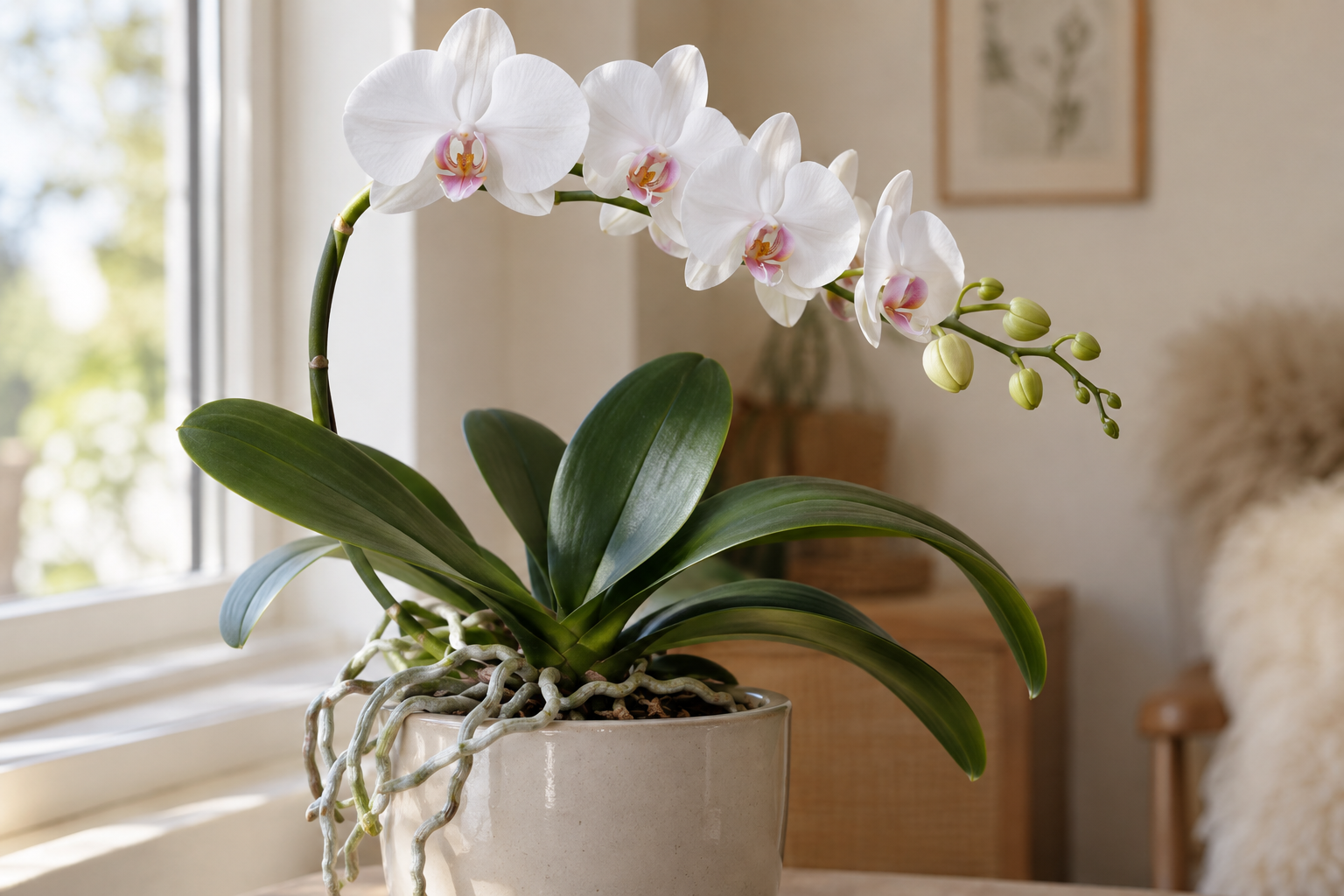
Phalaenopsis illustrates the orchid group here. Growth habit and rest requirements differ by genus.

Leaves, new roots and shoots reveal how your orchid is developing. Match care to its genus and actual growth.

Phalaenopsis hybrids can bloom at different times of year. Fertiliser supplies nutrients; light, temperature and plant condition also shape development.

The illustration shows an aerial root above the pot rim. Preserve firm roots and do not force them into the medium. Silvery colour alone does not establish disease.

Choose particle size for the orchid genus, roots and watering method. Allow for starter nutrients when feeding.

Bark, coir fibre and perlite for suitable young potted orchids. Choose according to growing requirements.

10 litres of MK orchid medium plus 250 ml fertiliser. Already includes this fertiliser.


Leaves use light; roots take up water and mineral nutrients. The diagrams show how plant organs work together and how nutrients are absorbed.
Many epiphytic orchids have a multilayered root covering called velamen, which helps contact with water. Living tissues inside control nutrient uptake. Preserve firm aerial roots.
Healthy leaves supply the plant with sugars. Avoid direct summer sun and standing water in the crown; individual old leaves may naturally die back.
Phalaenopsis grows from a continuing main axis. Dendrobium may form storage canes. Living storage canes are not spent flower spikes and should not be routinely cut back.
Nitrogen supports chlorophyll and protein formation. Phosphorus contributes to energy transfer, while potassium supports water regulation and transport. The formulation supplements these minerals and declared micronutrients; it cannot replace suitable light and root conditions.
Select a point in the picture or choose a stage.
Stage 01 / 04
Dissolved nutrients reach pre-moistened roots in the airy orchid medium when watering. Let excess solution drain afterwards.
Good to knowAlways dilute the concentrate and keep to the stated dosage.
Dissolved nutrients reach pre-moistened roots in the airy orchid medium when watering. Let excess solution drain afterwards.
Stage 02 / 04
The root covering of many epiphytic orchids, the velamen, supports contact with water. Nutrients must then pass into living tissues.
Good to knowRoots take up nutrients; they do not simply absorb all the fertiliser along with the water.
The root covering of many epiphytic orchids, the velamen, supports contact with water. Nutrients must then pass into living tissues.
Stage 03 / 04
Cell membranes and transport proteins control uptake of dissolved minerals. Water movement and nutrient uptake are different processes.
Good to knowMore fertiliser does not automatically mean better nutrition.
Cell membranes and transport proteins control uptake of dissolved minerals. Water movement and nutrient uptake are different processes.
Stage 04 / 04
Vascular tissue connects roots and aerial parts. Water and absorbed nutrients can be transported through the xylem.
Good to knowHealthy roots and suitable growing conditions are important for nutrient supply.
Vascular tissue connects roots and aerial parts. Water and absorbed nutrients can be transported through the xylem.
Stage 01 / 04
Use only prepared diluted solution. Avoid open flowers and the crown; count foliar feeding towards total nutrition.
Good to knowFoliar feeding is not an automatic extra dose of fertiliser.
Use only prepared diluted solution. Avoid open flowers and the crown; count foliar feeding towards total nutrition.
Stage 02 / 04
The leaf surface protects the plant. Dissolved nutrients can pass through this layer; tiny openings in the leaf may also play a part. Uptake varies with the type of leaf and the conditions.
Good to knowDifferent leaves do not absorb a nutrient solution equally well.
Dissolved nutrients can pass through the protective cuticle; pathways involving stomata may also contribute. Their relative importance varies with plant species and conditions.
Stage 03 / 04
Behind the surface lies living leaf tissue. Its cells can take up nutrients that have crossed the surface and use them for their activities.
Good to knowA droplet on a leaf does not yet mean its nutrients have been absorbed.
After crossing the surface, nutrients can be taken up by living leaf cells. The amount depends on factors including the nutrient, formulation and environmental conditions.
Stage 04 / 04
The plant can use absorbed nutrients within the leaf. Some can also reach other plant parts. This depends on the nutrient and the plant's condition.
Good to knowFoliar feeding does not mean every nutrient immediately reaches the whole plant.
Absorbed nutrients can be used within the leaf. Whether and how far they move to other plant parts depends on the nutrient and the plant's condition.
Development influences requirements
After repotting, check stability, root condition and drainage first. Count nutrients already in the medium; do not automatically start extra feeding.
Active roots, new leaves or shoots indicate development. Feed at the declared interval; stronger solution does not force flowering.
Phalaenopsis remains in warm cultivation. Some Dendrobium groups need different rest conditions. Identify the group and do not feed by calendar during rest.
Flowers alone do not measure feeding demand. Assess growth, roots and existing nutrients together.
Application & calculator →Adapt care to the growing conditions and stage of growth. If you notice changes, check light, water and roots first — then take targeted action.
Choose suitable bark-based medium and free drainage for Phalaenopsis. A clear pot helps inspect the roots. Do not leave solution in the outer pot.
Place Phalaenopsis in bright light protected from direct summer sun. Avoid draughts and heater heat; assess other orchid groups separately.
Lower light can reduce water and nutrient demand. Observe the plant and apply the label interval only during active growth.
Repot when the medium breaks down or space runs out, preferably while roots are active. Preserve firm aerial roots without forcing them into the medium. Select particle size to suit roots and watering.
Both shortage of water and damaged roots can produce limp leaves. Check root firmness and medium moisture before watering more often.
Remove standing water from a Phalaenopsis crown. Isolate plants with soft, rapidly spreading patches and seek diagnosis; use separate containers.
Inspect leaf axils, undersides and spike nodes for mealybugs or scale. Observe new plants separately at first; identify the pest before selecting treatment.
These details help assess growing conditions, root problems or a possible infestation:
Discoloured leaves do not confirm nutrient deficiency. Identify pests and select treatment suitable for the plant and location.

Phalaenopsis, Dendrobium and other groups: distinguish growth, care and rest.
View the plant profile
Consider pre-fertilised medium and extra feeds together: the guide explains the relationship.
Read the plant nutrition guideFeed orchids to match genus, growth stage and growing conditions.
Dilution: 5 ml per 2.5 l of water.
Measure out the concentrate and mix it with the stated amount of water. Never apply undiluted.
Calculated at the stated standard dilution; the amount needed per application depends on the plant and growing conditions.
Do not apply in sunlight, below 5 °C or above 30 °C. Never apply the concentrate undiluted.
SDS – Safety data sheet available on request.
Avoid contact with eyes, skin and clothing. Do not inhale spray mist. Wear protective clothing, rubber gloves and safety glasses when handling the product. Keep away from food and beverages. Wash your face and hands thoroughly after use. Official advisory recommendations take precedence. Fertilisers may leave permanent stains on surfaces. Do not allow fertiliser to enter bodies of water or wastewater.
Official advisory recommendations take precedence.
Wash your face and hands thoroughly. Use diluted fertiliser promptly and keep it out of water bodies and wastewater.
The original leaflet explains safe mixing and use. Follow the orchid product’s own dilution and application limits.
Store in a dry, dark place above +8 °C and no higher than +38 °C. Keep out of reach of children and animals.
Keep tightly closed in the original container, separate from food and animal feed.
Store dry and dark, above 8 °C and at no more than 38 °C. Keep in the tightly closed original container away from food and feed. Use diluted solution promptly.
Do not allow fertiliser residues or rinsing water to enter waterways or wastewater. Follow the disposal instructions on the packaging.
Measure concentrate accurately and apply only after dilution. More fertiliser does not compensate for insufficient light, drought or damaged roots.

For comparison when growing Phalaenopsis. Select a suitable product and avoid duplicate feeding.

Three separate fertilisers for orchids, foliage plants and flowering houseplants. Follow each bottle’s own label.