

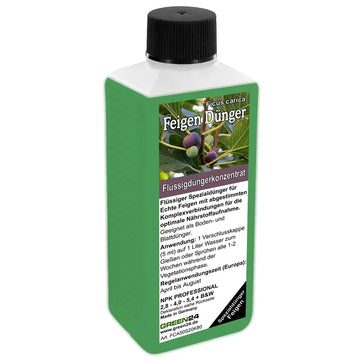
Water-soluble & available
All nutrients are water-soluble. In the fully diluted mixture, they are available for feeding through roots and leaves.


Start simply · explore when you want
The common fig, Ficus carica, is a deciduous fruiting woody plant. Start with simple application, then explore care for containers, open ground and trained forms. This does not refer to ornamental ficus species such as weeping fig or rubber plant.
For common fig, Ficus carica, in containers and gardens. This plant knowledge does not apply generally to ornamental indoor ficus species.
During active growth, normally April–August. Consider warmth, soil moisture, cultivar and existing nutrients together.
After planting or repotting, account for pre-fertilisation in the compost. If roots are dry or damaged, address growing conditions first.
Application in one place
Enter the water volume you need, or use the height and crown width of a single leafy fig as a rough watering guide. For flat-trained forms, use the water volume actually needed.
1 capful = 5 ml. Use a suitable measuring aid for smaller partial amounts.
Enter a water amount from 0.1 to 1,000 litres.
A rough guide only for watering the roots of a single leafy fig, not for foliar spraying. Measure height from soil level and overall crown width. Check root space, root-ball moisture, soil, weather and training; enter actual water volume for trained flat forms and during leafless dormancy.
General GREEN24 guide: height (m) × width (m) × 3–4 litres. Centimetres are converted to metres. The concentrate amount follows this fertiliser’s standard dilution. The estimate does not measure individual water requirements.
Use a clean watering can or sprayer; preferably low-lime water or rainwater at 15–25 °C.
Enter the water volume. When using the size-based guide, also check root space and actual root-ball moisture.
Start by filling the container with part of the chosen water volume.
Shake the bottle. 1 capful = 5 ml; use a measuring aid for smaller partial amounts.
Add the calculated amount of concentrate to the water.
Top up to the chosen water volume and mix well. Watering or spraying: see below.
When to feed? Every 1–2 weeks during active growth, normally April–August. Water between feeds according to actual need. Account for pre-fertilisation and do not continue the summer feeding schedule during winter dormancy.
Pre-moisten the root zone and distribute the mixture evenly. Excess water must be able to drain from fig containers. In open ground, apply to the rooted area; trunk height alone does not determine water volume.
Finely wet the lobed fig leaves in the morning, evening or under overcast skies. Foliar applications form part of the same feeding plan as root applications, not an automatic addition. The general instruction to avoid open flowers still applies; fig flowers are inside the syconium.
Net mass: 281 g for 250 ml; 1124 g for 1 litre.
The dilution is the same for both pack sizes.
| Pack size | Price |
|---|---|
| 250 ml | €9,85 EUR |
| 500 ml – twin pack (2 × 250 ml) | €18,95 EUR |
| 1 litre | €29,95 EUR |
Declared nutrient percentages. Product pH: 6.5.
Pre-fertilised soil and fertiliser already in the root ball contribute to the nutrient supply. Each of the four care products listed below can be mixed with our liquid fertiliser. When applying them together, follow both products’ specific instructions; conflicting or stricter directions take precedence. Do not mix undiluted concentrates.
Our fig fertiliser is individually compatible with Schädlings-Frei Organic, Trauermückenfrei Organic, KIRON Milben-Ex or Rosen Pilz-Frei BOCCACIO. This applies to fertiliser plus one product at a time, not to every use on edible figs. Follow both sets of instructions, including crop, site of use and pre-harvest interval.
Request the compatibility table →Beyond NPK · understand the formulation
Water-soluble nutrients and coordinated formulation properties support your fig’s nutrition. The diluted mixture is applied to the root zone or the lobed leaves.
All nutrients are water-soluble. In the fully diluted mixture, they are available for feeding through roots and leaves.
Copper, iron, manganese and zinc are declared as EDTA chelates. This binding helps keep these trace nutrients available in solution.
The buffer system helps regulate the pH of the finished watering or spraying solution. The source water also influences the resulting value.
Good wetting and adherence help distribute the spray solution across the leaves. Dissolved nutrients are then available at the leaf surface for uptake.
The formulation helps reduce adverse hard-water effects and deposits on the leaves. Low-lime water or rainwater provides a good starting point.
High plant compatibility when applied correctly supports feeding of growing figs. An aerated root zone, suitable moisture and light remain equally important for development.
Nutrients support leaf formation, metabolism and fig development. Leaf finish describes a well-kept appearance, not an applied glossy film. This does not imply a specific fruit number, sweetness or ripening date; cultivar, light, warmth and water also contribute.
Chelation can reduce interfering effects of water hardness; it does not remove calcium and magnesium from the water. The product pH of 6.5 describes the concentrate, not the soil. The pH of the prepared mixture also depends on the source water; no fixed target value is promised.
Use clean, suitable watering or spraying equipment. Measure the water and calculated concentrate quantity carefully.


The fig through the seasons
A fig changes its place in the garden through summer: the crown fills with leaves, new shoots grow and figs develop according to cultivar. Follow the development of your own plant. Warmth and a suitable position remain important for ripening.
Nutrition is one part of fig care. Even moisture, warmth and sufficient light work alongside healthy roots to support development. Cultivar, pruning and weather also influence which figs can ripen.
The large lobed leaves use light to produce sugars. The shape and depth of the lobes can vary even on one plant. The foliage is shed in autumn.
The tiny flowers are inside the fig’s syconium, rather than exposed on the branches. Fruit set and ripening depend partly on fig type, cultivar, warmth and water. Not every cultivar develops ripe fruit without pollination.
Young shoots develop leaves and, depending on the cultivar, fruit. Pruning and frost can change the available fruiting wood. Preserve the shoots important to your cultivar rather than treating long shoots alone as a sign that more feeding is needed.
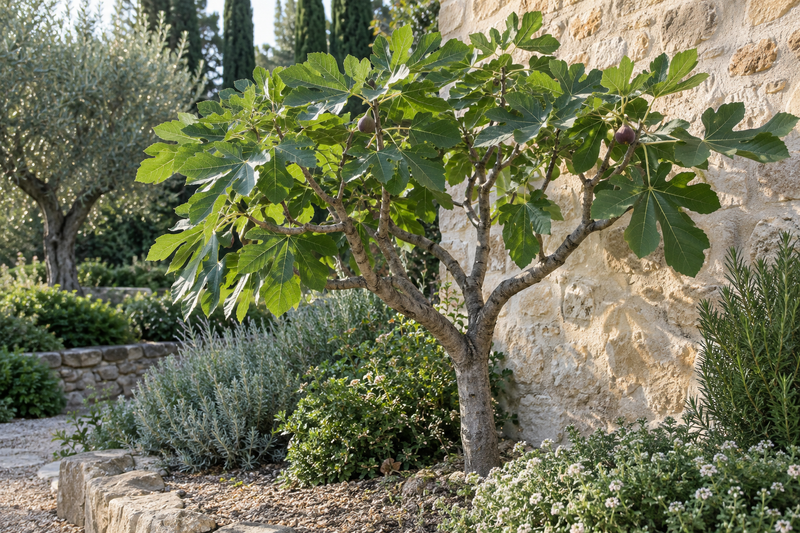
A warm, sunny and sheltered position suits a fig. Allow for its eventual crown width and available root space, whether grown in a container, as a bush or as a trained plant.
From roots to the syconium
The fig’s fine roots take up water and dissolved nutrients from the soil. Its lobed leaves use light to produce sugars for growth and maintenance. Young shoots carry new leaves and, depending on the cultivar, fruit, while woody branches build the crown. Nitrogen contributes to proteins and chlorophyll, phosphorus to energy transfer and potassium to water regulation. Ripening figs also require a suitable combination of cultivar, warmth, light and water supply.
A fig needs an aerated root zone. Moisture enables contact with dissolved nutrients; persistently wet soil harms roots. Drainage and available root space therefore matter as much as feeding in containers.
Young fig shoots become woody and form the framework of the crown. Conducting tissues move water and substances between plant parts. Depending on cultivar, current-season or overwintered wood contributes to fruit development, so consider the fruiting type when pruning.
Nutrients support metabolic processes in leaves but do not replace sunlight. Keep healthy leaves rather than removing them indiscriminately in an attempt to ripen fruit. Leaf lobing and size can vary; their seasonal role ends with autumn leaf fall.
The edible fig is a distinctive fruiting structure. Sugars from the leaves and suitable water and nutrient supplies contribute to its development. Not every cultivar ripens figs without pollination; feeding changes neither the fig type nor an insufficient warm ripening period.
Understanding plant feeding
In spring, the fig develops new shoots and its large, lobed leaves. Using light, the leaves produce sugars that are also needed for fig development. Dissolved nutrients enter the plant from the soil through absorbing root regions. The fertiliser can also be sprayed onto existing leaves; both routes belong to the same feeding plan. Whether figs ripen also depends on cultivar, warmth and water supply. The stages show uptake and transport as a functional diagram.
Select a point in the picture or choose a stage.
Stage 01 / 04
In pre-moistened soil, the diluted mixture meets fine root areas. Dissolved nutrients are available for uptake at the contact surface.
Good to knowAlways dilute the concentrate and keep to the stated dosage.
Watering carries dissolved nutrients into the growing medium around the roots. Contact with the absorbing root surfaces is the first step.
Stage 02 / 04
Fine root hairs increase contact with the soil. Transport proteins in cell membranes help take up dissolved nutrients.
Good to knowRoots take up nutrients; they do not simply absorb all the fertiliser along with the water.
Root hairs increase the contact area. Transport proteins in cell membranes enable mineral ions to enter; water movement and nutrient uptake are distinct processes.
Stage 03 / 04
Nutrients pass through regulated steps in root cells. The fig is not simply flushed through with the entire contents of the watering solution.
Good to knowMore fertiliser does not automatically mean better nutrition.
Controlled steps within root tissue lie between the root surface and onward transport. Transport across cell membranes enables nutrient uptake; water movement and nutrient uptake are different processes.
Stage 04 / 04
Water and absorbed nutrients can move through the xylem to above-ground parts. Healthy roots and active leaves are part of this process.
Good to knowHealthy roots and suitable growing conditions are important for nutrient supply.
After entering the vascular tissue, nutrients can travel with the water stream in the xylem towards the shoot. Uptake and nutrient supply also depend on root health and growing conditions.
Stage 01 / 04
The diluted mixture reaches the lobed leaf surface. Apply in the morning, evening or under overcast skies and observe the temperature limits.
Good to knowFig fertiliser is also suitable for foliar application. Use only after dilution and include foliar feeding in the overall feeding plan.
Foliar feeding places diluted nutrient solution on the leaf surface. Wetting depends on factors including the leaf surface and the solution.
Stage 02 / 04
Dissolved nutrients can cross the protective surface layer; routes involving small leaf openings may also contribute. Conditions and leaf characteristics affect uptake.
Good to knowDifferent leaves do not absorb a nutrient solution equally well.
Dissolved nutrients can pass through the protective cuticle; pathways involving stomata may also contribute. Their relative importance varies with plant species and conditions.
Stage 03 / 04
After crossing the surface, living leaf cells can take up nutrients and use them in metabolism. A visible droplet alone does not demonstrate this step.
Good to knowA droplet on a leaf does not yet mean its nutrients have been absorbed.
After crossing the surface, nutrients can be taken up by living leaf cells. The amount depends on factors including the nutrient, formulation and environmental conditions.
Stage 04 / 04
Absorbed nutrients can be used in the leaf or moved elsewhere depending on the nutrient. This does not imply an immediate, even supply to all figs.
Good to knowFoliar feeding does not mean every nutrient immediately reaches the whole plant.
Absorbed nutrients can be used within the leaf. Whether and how far they move to other plant parts depends on the nutrient and the plant's condition.
Development influences requirements
First establish root contact, suitable moisture and a stable position. Pre-fertilised compost already contributes nutrients. A small plant height does not imply an additional dilution stage; the confirmed standard concentration remains unchanged.
Shoots and leaves grow during the active season, with figs developing according to cultivar. Coordinate feeding at the stated interval with moisture conditions. If figs drop or fail to ripen, check cultivar, weather and water before increasing the concentration.
The common fig sheds its leaves. Pause feeding during dormancy and adjust watering to the much lower demand without letting a container root ball dry out completely. Frost protection depends on cultivar, position and growing method.
Consider cultivar, season, roots and existing nutrients together. Height determines neither a different dilution nor individual water demand.
Application & calculator →Your growing conditions matter
A fig can grow in a container, in the garden or as a trained form. A warm microclimate and protection from adverse weather help guide the choice of position. A deciduous fig is not an evergreen indoor ornamental plant.
Use a stable container with drainage holes and sufficient root space. Its limited root ball can dry faster in summer than garden soil. Check moisture regularly and include existing pre-fertilisation when planning further feeding.
Plant in a sunny, sheltered position and allow space for the mature crown. Check root-zone moisture while the plant establishes. Soil structure and drainage take priority over simply increasing fertiliser quantities.
Container roots are more exposed to cold than roots in garden soil. Choose protection and an overwintering position for the cultivar and local conditions. Do not continue summer feeding during leafless dormancy; regrowth after frost does not necessarily mean fruiting wood survived.
Arrange shoots clearly in fan-trained or espalier forms and account for your cultivar’s fruiting habit. Hard pruning can remove fruiting wood. For flat forms, enter the actual water volume in the calculator rather than treating wall area as a free-standing crown.
Tree & Shrub Compost is a general substrate option for woody plants in containers or open ground, not a specifically tested fig compost. The Mediterranean Orchard Fertiliser Set is intended for a collection of different plants; its individual fertilisers are not a combined mixture.

General compost for trees and shrubs. Plan drainage and root space to suit the fig, and account for existing pre-fertilisation.

A set for different Mediterranean plants. Select the suitable individual fertiliser and follow its own application instructions.
Understand plant care problems
Yellow leaves, premature fig drop and fruit that fails to ripen have different causes. Check the cultivar, warmth, soil moisture and root condition. More fertiliser cannot replace a suitable position or the conditions your cultivar requires.
Pale stippling, dull foliage and fine webbing can indicate spider mites, particularly in warm, dry conditions. Inspect leaf undersides with a hand lens. Yellow leaves alone are not enough for diagnosis.
Fixed scale-like bumps or cottony deposits on shoots and leaf bases are suspicious. Some species produce sticky honeydew. Check newly acquired and overwintered container plants; do not mistake normal bark features for insects.
Irregular yellow-green patches and distorted leaves can be consistent with fig mosaic. A photograph does not confirm the cause, and other damage may look similar. Do not propagate from suspicious shoots; seek assessment if symptoms persist.
Wilting despite damp soil can indicate root problems. Whitish fungal sheets beneath dead bark at the trunk base may be consistent with honey fungus. Have the cause and extent assessed; extra watering does not repair a damaged root system.
Check root-ball moisture, drainage, heat, previous feeding and plant age. Distinguish natural autumn leaf fall from losses during active growth. Cultivar and pollination requirements can also contribute to fruit drop.
Shoots may die back after a cold winter, followed later by new basal growth. This is not evidence of a pest infestation. A fig regenerating from its roots may set fruit too late that year.
These details help assess growth, fruit development and possible damage:
Autumn leaf fall is part of dormancy. Premature leaf or fruit drop needs assessment alongside weather, water, roots and cultivar. A single symptom does not prove a nutrient deficiency or a particular disease.
These four care products are individually compatible with our liquid fig fertiliser.
Dr. Stähler
€16,95
Insect control: check the pest, plant species and authorised application site.
Mixable with GREEN24 liquid fertilisersView product & applicationDr. Stähler
€9,99
For fungus gnat larvae: follow the authorised crop and watering application.
Mixable with GREEN24 liquid fertilisersView product & applicationDr. Stähler
€12,95
Mite control: identify the infestation and follow the authorised application.
Mixable with GREEN24 liquid fertilisersView product & applicationDr. Stähler
€13,95
Fungal control: check the disease, plant species and authorised growing situation.
Mixable with GREEN24 liquid fertilisersView product & applicationMixability applies to fertiliser plus one product at a time, not to all products mixed together. Follow crop, pest, application site, dose, waiting periods and the stricter requirements of both sets of instructions. Do not mix undiluted concentrates.
Use plant protection products safely. Always read the label and product information before use.
For common fig, Ficus carica, in containers and gardens. This plant knowledge does not apply generally to ornamental indoor ficus species.
Dilution: 5 ml per 1 l of water.
Measure out the concentrate and mix it with the stated amount of water. Never apply undiluted.
Calculated at the stated standard dilution; the amount needed per application depends on the plant and growing conditions.
Do not apply in sunlight, below 5 °C or above 30 °C. Never apply the concentrate undiluted.
SDS – Safety data sheet available on request.
Avoid contact with eyes, skin and clothing. Do not inhale spray mist. Wear protective clothing, rubber gloves and safety glasses when handling the product. Keep away from food and beverages. Wash your face and hands thoroughly after use. Official advisory recommendations take precedence. Fertilisers may leave permanent stains on surfaces. Do not allow fertiliser to enter bodies of water or wastewater.
Official advisory recommendations take precedence.
Wash your face and hands thoroughly. Use diluted fertiliser promptly and keep it out of water bodies and wastewater.
Store in a dry, dark place above +8 °C and no higher than +38 °C. Keep out of reach of children and animals.
Keep tightly closed in the original container, separate from food and animal feed.
Avoid large temperature fluctuations. Temperature-related discolouration or crystals may occur; the crystals dissolve by the dilution stage at the latest and do not impair product quality. For this fertiliser, store dry and dark above 8 °C and at no more than 38 °C. Use diluted fertiliser promptly.
Do not allow fertiliser residues or rinsing water to enter waterways or wastewater. Follow the disposal instructions on the packaging.
Measure concentrate accurately and apply only after dilution. More fertiliser does not compensate for insufficient light, drought or damaged roots.
The original leaflet explains safe preparation and application. Use this fig concentrate’s own dilution in the calculator and account for root and foliar applications together.
More products to compare and discover.

Compare within the range: Apricot Fertiliser.

Compare within the range: Apple Tree Fertiliser.


