


Schädlings-Frei-Organic
€16,95
For spraying or watering, depending on the authorised use. The method depends on the plant, pest and location.
View product in our shop →


Apricot Fertiliser
Liquid NPK concentrate for apricot trees (Prunus armeniaca). Dilute with water before use.
With declared trace nutrients.
One capful equals 5 ml according to the label.
Pre-water the root zone; avoid open flowers.
Apply every two weeks.
The product label takes precedence. Also consult the application leaflet.
Original leaflet 130405 – liquid fertilisers (PDF, German) Opens in a new window.Feed according to nutrient needs. Fertiliser cannot replace unsuitable or over-fertilised growing medium.
Apricot Fertiliser: correct dosage
Enter your water volume or estimate the amount from the size of your plant.
Enter the water volume in litres. The calculator works out the concentrate needed. View application
Width and height give a rough guide for one root application. Choose m or cm. View application
Crown width and total tree height give a rough guide for one root application. View application
Enter the length and height of the whole hedge section. The result is for that section, not each plant. View application
Hydroponics needs product- and system-specific instructions. No permanent nutrient solution is calculated here. View application
Dosing equipment depends on flow, mixing ratio and device settings. This mode provides guidance rather than a universal dose. View application
* Severe deficiency, heavy feeders, intensified feeding. Increases the indicative application volume, not the concentration.
Please enter valid positive numbers. A comma or full stop can be used as the decimal separator.
Shake well before use. Add the concentrate and mix thoroughly.
Dilution: 5 ml concentrate per 1 litre of water. The leaflet recommends half strength for young and sensitive plants.
Choosing 3 or 4 litres changes the approximate amount of prepared solution to apply. The concentration is determined separately by the selected growth stage. Always mix according to the label.
A rough guide for one root application, not an exact water requirement: use your usual watering volume and the substrate’s capacity as a guide. Water the root zone first, then distribute the fertilizer solution evenly. This is not a spray volume for foliar feeding.
The calculated amount is for the entire hedge section entered, not for each individual plant.
Guide: plant width × plant height × 3 litres of prepared solution; for increased nutrient deficiency, × 4 litres. All dimensions in metres. Measurements entered in centimetres are automatically converted to metres.Guide for standards and trees: crown width × total tree height × 3 litres of prepared solution; for increased nutrient deficiency, × 4 litres. All dimensions in metres. Measurements entered in centimetres are automatically converted to metres.Guide for the whole hedge: hedge height × hedge length × 3 litres of prepared solution; for increased nutrient deficiency, × 4 litres. All dimensions in metres. Measurements entered in centimetres are automatically converted to metres.
Hydroponics requires product- and crop-specific instructions. The watering dilution above is not a guide for a permanent nutrient solution. This calculator therefore does not calculate hydroponic doses, EC targets or top-up amounts for this fertiliser concentrate. Please discuss the product and your hydroponic system with our advisers.
Contact our advisers →Dosing units, irrigation systems and fertilizer injectors need settings suitable for the product and equipment. Plant size alone cannot determine pump settings, running time or a stock solution.
Add 5 ml concentrate to 1 litre of water and mix well. One capful equals 5 ml according to the label. Apply by watering or spraying every two weeks during the growing season.
The leaflet recommends half strength for young and sensitive plants: 2.5 ml per 1 litre of water. Try it on a test plant first and observe the response.
Follow the product label and leaflet 130405 before use. The leaflet provides additional guidance on using the concentrate safely.
Please follow the product-specific information on the label and in the full description.
The general information sheet describes liquid fertilizer concentrates. Ready-to-use and solid fertilizers have their own application instructions on the product label.
Liquid NPK concentrate for apricot trees (Prunus armeniaca), suitable for root and foliar feeding.
The twin pack contains two unchanged 250 ml bottles. The dilution stays the same.
Net mass excludes the packaging. The twin-pack total is calculated from two individual bottles.
NPK fertiliser solution 6.5+4.5+6.8. Product pH as declared on the label: 6.9.
Using products as part of the same care routine is different from mixing them in one container. Follow the labels and application instructions of all products involved.
The recommendations cover products for different care tasks. Combining them in the same solution requires the instructions for both products to allow that combination. Otherwise, apply the products separately.
Selected additions for your plant care.

For handling growing medium when planting or repotting.

For collecting removed plant material and tidying up.


PRODUCT KNOWLEDGE
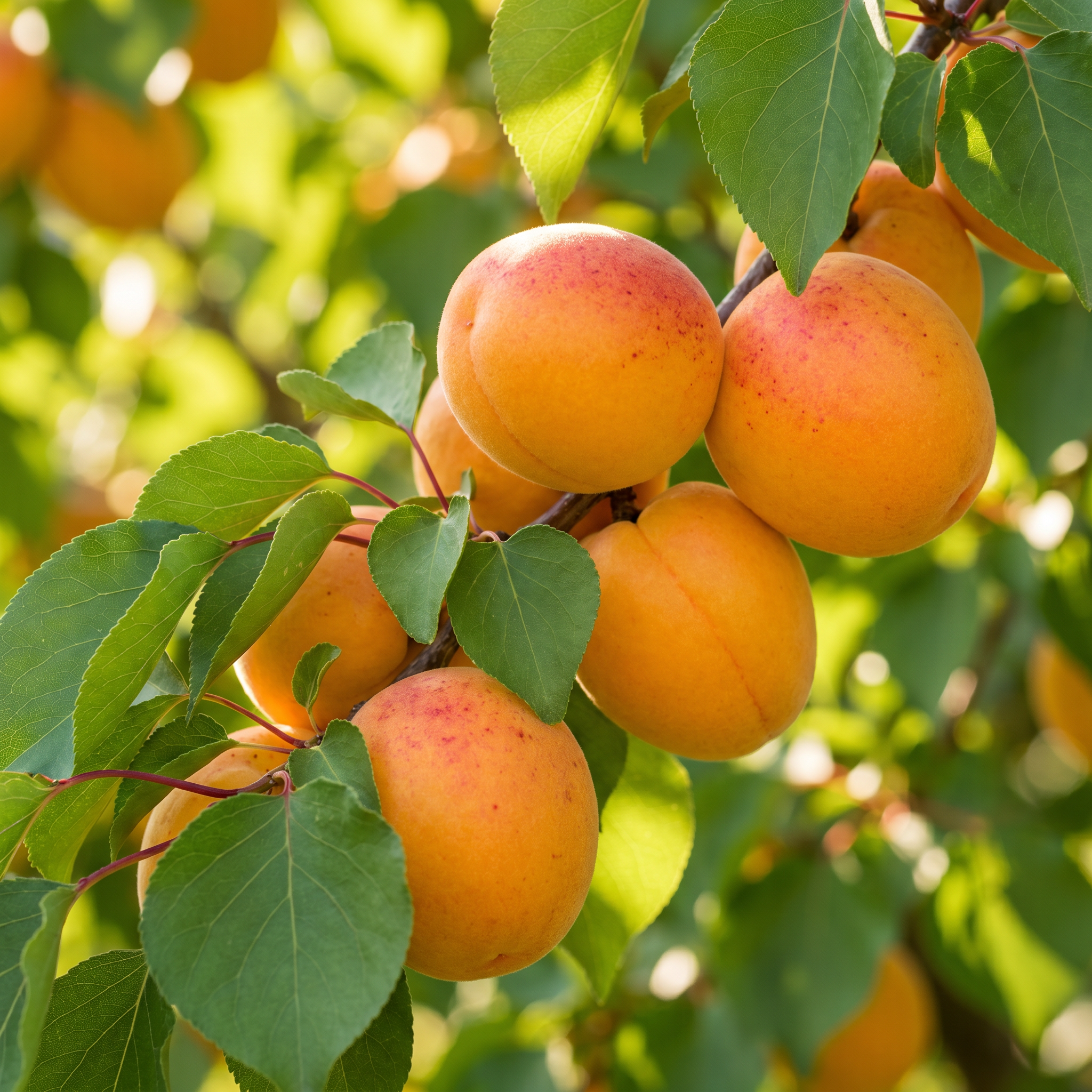
Suitable nutrient supply complements the light and watering care of your apricot tree.
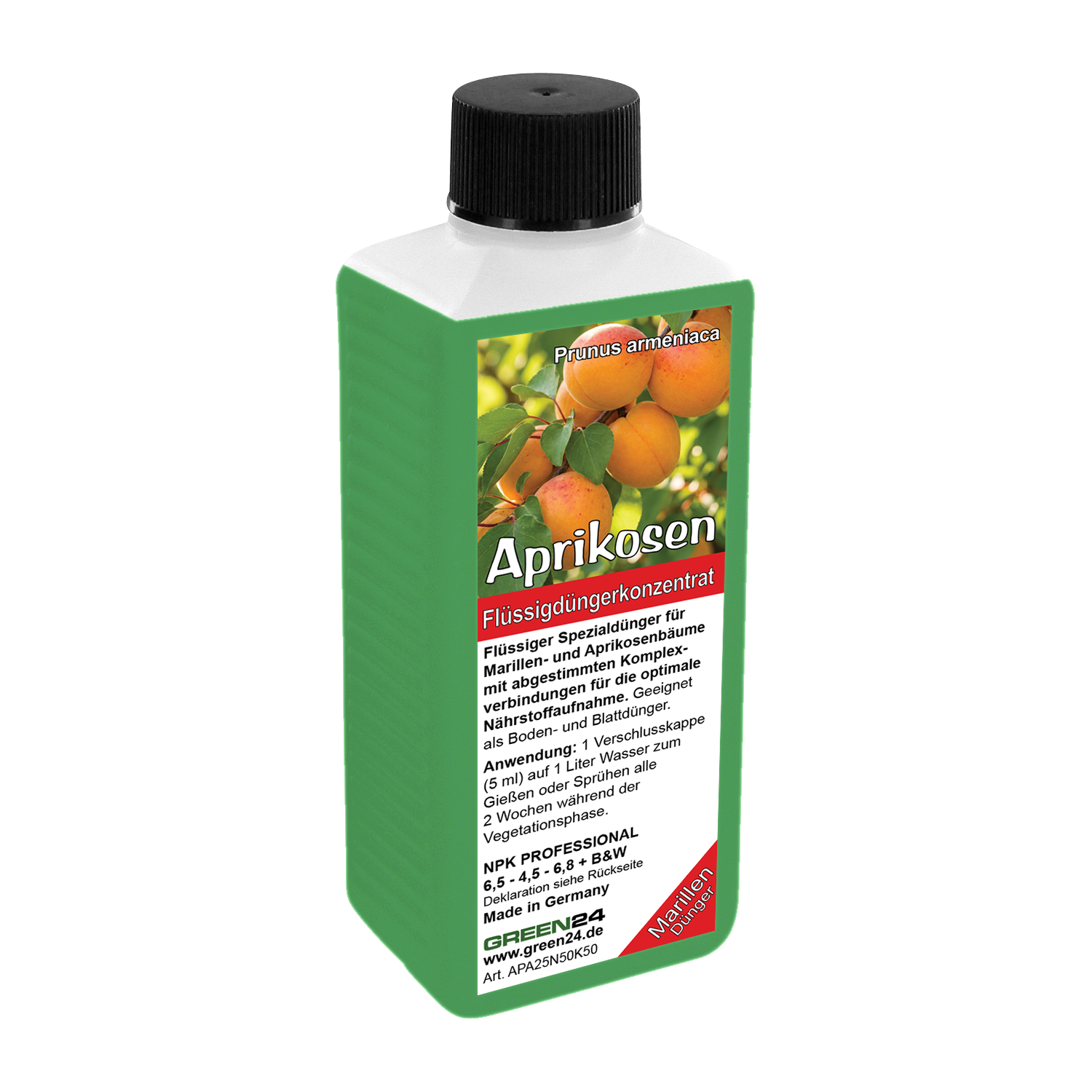
GREEN24 Apricot Fertiliser is a liquid NPK concentrate for apricot trees (Prunus armeniaca). The German names Aprikose and Marille on the front label refer to this plant. Dilute the concentrate with water before watering or spraying.
The twin pack provides a larger supply. Each bottle and its concentration remain unchanged, so the same volume of water does not require more concentrate.
Measure the amount required for Apricot Fertiliser according to its own label and add it to water. Mix well and apply during the specified growth period. The calculator and illustrated steps help with preparation.
Prepare the amount of nutrient solution you need. The dilution depends on this product and the required amount of water.
Clean the watering can, sprayer or bucket and rinse it with clean water.
Choose the amount of water you need and calculate the matching concentrate dose. The dosage calculator helps you do this.
Dilution: 5 ml per 1 l of water
Calculate the right amount →Pour part of the calculated amount of water into the container first.
Shake the closed bottle well. Then open it and measure the calculated concentrate dose with the dosing cap. Measure more than once if needed.
Measure the concentrate using suitable millilitre graduations.
Pour the measured concentrate into the water already in the container.
Add the rest of the calculated water and mix thoroughly. Your diluted nutrient solution is ready.
Shake well before use. Choose the volume of water and measure the calculated concentrate dose. Pack size does not change the dilution.
Preferably use low-lime water or rainwater at 15–25 °C. Add the measured concentrate to the water and mix thoroughly. Never apply undiluted; prepare only what you need.
Check growth, growing-medium moisture and previous feeding. Feed only during active growth.
Application period: During the growing season
For root feeding, moisten dry growing medium with water first. Check drainage; the pot should not remain standing in water.
Distribute the diluted solution over the pre-moistened root zone or spray the foliage. Do not spray open flowers. Do not apply in direct sunlight, below 5 °C or above 30 °C. Do not inhale spray mist.
Follow the safety instructions →Measure the required water volume. Then add the calculated concentrate volume and mix well. The amount of water and the concentration of the solution are separate quantities.
The label allows watering or spraying. Pre-water the root zone for soil application. For foliar feeding, follow the mandatory guidance on weather and open flowers. The label rate remains the basis for both application methods.
Leaflet 130405 recommends half strength for young and sensitive plants. Observe special dilution rates on a test plant first. A compact habit or a container alone does not make an established tree a young plant.
Apricots need a warm, sunny position together with effective drainage. In containers, even moisture and sufficient root space matter particularly during growth and fruit development.
Dilute this liquid concentrate with water before root or foliar feeding. Its own declaration, pack sizes and yield are listed in the product information.
Understanding plant feeding
Through the roots or through the leaves: explore four steps to discover how a plant takes up and uses nutrients.
Select a point in the picture or choose a stage.
Stage 01 / 04
Dilute the fertiliser with water according to the label. Watering carries this nutrient solution into the soil or growing medium around the roots.
Good to knowAlways dilute the concentrate and keep to the stated dosage.
Watering carries dissolved nutrients into the growing medium around the roots. Contact with the absorbing root surfaces is the first step.
Stage 02 / 04
Fine root hairs increase contact with the growing medium. Tiny transport proteins in the membranes surrounding root cells help dissolved nutrients enter the cells.
Good to knowRoots take up nutrients; they do not simply absorb all the fertiliser along with the water.
Root hairs increase the contact area. Transport proteins in cell membranes enable mineral ions to enter; water movement and nutrient uptake are distinct processes.
Stage 03 / 04
On their way into the root, nutrients meet a special layer of cells. It prevents substances from simply flowing through the gaps between cells and helps the plant control uptake.
Good to knowMore fertiliser does not automatically mean better nutrition.
Nutrients move through the root tissues. The endodermis acts as a control layer: its barrier interrupts unrestricted movement along the cell walls.
Stage 04 / 04
Inside the root are fine transport channels called xylem. Water and absorbed nutrients can travel through them towards shoots and leaves.
Good to knowHealthy roots and suitable growing conditions are important for nutrient supply.
After entering the vascular tissue, nutrients can travel with the water stream in the xylem towards the shoot. Uptake and nutrient supply also depend on root health and growing conditions.
View original diagram ↗GREEN24 diagram with German labels
Stage 01 / 04
For foliar feeding, diluted nutrient solution is sprayed onto the leaves. The product instructions tell you whether it is suitable for this use and how much to apply.
Good to knowSpray only as directed by the product instructions, never with undiluted concentrate.
Foliar feeding places diluted nutrient solution on the leaf surface. Wetting depends on factors including the leaf surface and the solution.
Stage 02 / 04
The leaf surface protects the plant. Dissolved nutrients can pass through this layer; tiny openings in the leaf may also play a part. Uptake varies with the type of leaf and the conditions.
Good to knowDifferent leaves do not absorb a nutrient solution equally well.
Dissolved nutrients can pass through the protective cuticle; pathways involving stomata may also contribute. Their relative importance varies with plant species and conditions.
Stage 03 / 04
Behind the surface lies living leaf tissue. Its cells can take up nutrients that have crossed the surface and use them for their activities.
Good to knowA droplet on a leaf does not yet mean its nutrients have been absorbed.
After crossing the surface, nutrients can be taken up by living leaf cells. The amount depends on factors including the nutrient, formulation and environmental conditions.
Stage 04 / 04
The plant can use absorbed nutrients within the leaf. Some can also reach other plant parts. This depends on the nutrient and the plant's condition.
Good to knowFoliar feeding does not mean every nutrient immediately reaches the whole plant.
Absorbed nutrients can be used within the leaf. Whether and how far they move to other plant parts depends on the nutrient and the plant's condition.
View original diagram ↗GREEN24 diagram with German labels
The product supplies nutrients to the plants identified on its label. Pre-fertilised growing medium and previous feeding already contribute to the overall supply and must be taken into account.
Changes in leaves, fruit drop or weak shoot growth are not enough on their own to determine a fertiliser amount. Record the growing position, moisture, previous care and observed changes for an informed consultation.
This fertiliser does not replace diagnosis of pest or disease problems, frost protection or suitable growing conditions. A higher concentration is not a general solution to plant damage.
The plant species, photographs and details of location, moisture and previous care help assess plant damage. Identify the cause and a suitable application before treatment.
More fertiliser is not a general solution to growing problems. A recommendation to buy products together does not confirm that they can be mixed.
General manufacturer information: these products have not been selected here as suitable treatments for the plant shown here. Before use, check the plant species, pest, application site and current instructions.


Use plant protection products safely. Always read the label and product information before use.
Care depends on whether your tree grows in garden soil, a container or as a trained fan. Choose the topic that matches your growing situation and task.

An apricot grown from a stone is a seedling, not a guaranteed copy of its parent. Fruit quality, growth and later yield may differ. Germination requires suitable moist cold treatment; a sowing experiment does not guarantee a crop.
To retain a particular cultivar, choose a named grafted plant. The rootstock influences vigour, among other characteristics. Label your own seedlings with their origin and sowing date so their development can be followed.
Start with experiences in the GREEN24 forum: Caring for young fruit trees (German) ↗ · Apricot from a stone (German) ↗. These are personal experiences; the guidance is checked against horticultural sources.
Cultivar and site-specific decisions remain individual. Follow the GREEN24 concentrate’s own label and linked application leaflet.
Choose a sunny, warm, sheltered position with reliable drainage. Avoid low spots where cold air collects: early apricot blossom is particularly vulnerable to late frost.
For containers and small gardens, cultivar, rootstock and training method determine the space needed. Record these details and any fertiliser already in the growing medium. Weak growth or changes in leaves alone do not establish a need for extra feeding.
In a container: Keep the root ball evenly moist during growth without waterlogging it. Check especially in warm weather and as fruit develops; drainage holes must remain clear.
In the garden: Water newly planted trees thoroughly during dry spells. Rainfall and soil moisture determine any extra water needed by established trees. Water the root zone; a fixed daily schedule does not suit every soil.
In the garden: Keep the root ball at its previous depth, with the graft union above the soil. Do not let exposed roots dry out, and water thoroughly after planting.
In a container: For long-term growing, use good-quality loam-based compost and a stable pot with drainage. Inspect root space regularly; densely crowded roots may need a slightly larger container. Account for fertiliser already present in the fresh compost.
For established apricots, plan maintenance pruning preferably just after harvest in summer. The Bavarian LWG identifies this as a favourable time for wound healing and light penetration. Fan-trained trees and free-standing crowns need different pruning methods.
Remove dead or damaged wood selectively and retain sufficient fruiting spurs. Young trees first need a sound framework. Plan major cuts with knowledgeable advice based on cultivar, tree condition and a photograph of the crown.
Protect the container: Place it in a sheltered position and insulate the pot during frost to protect its roots. Water must still drain away. An unheated greenhouse is one option for overwintering small container-grown apricots.
Protect blossom separately: Cover small trees or trained fans with fleece when overnight frost is forecast. Keep the material clear of flowers and uncover during the day for light and pollinators. This is difficult to achieve with large garden trees.
Do not add this fertiliser during dormancy. Follow the growing period stated on its label rather than a universal date or the harvest date alone.
When problems appear, first examine moisture, roots, weather and previous care. Photograph the changes. Product-specific directions are collected under Application & dilution.
Yes. The front label names apricot trees using both German names and the botanical name Prunus armeniaca.
No. The twin pack contains two unchanged 250 ml bottles. Prepare the solution using the same label rate. A larger supply does not mean a stronger mixture.
The front label specifies application every two weeks during the growing period. It does not set fixed months for every location. Follow the plant’s condition, label and leaflet.
The label provides for root and foliar feeding. Follow its instructions, particularly those about weather conditions and open flowers. The full guidance is under Application & dosage.
At the standard label rate of 5 ml per litre of water, 250 ml of concentrate treats 50 litres of water. The twin pack treats a calculated 100 litres of water. Add the concentrate to the water in each case. This yield does not determine how much an individual tree needs.
The back label specifies preferably lime-free water or rainwater at 15–25 °C. It does not give blanket approval for tap water of any hardness.
No. This product is a fertiliser for nutrient supply. Establish the cause of infestation or damage first. Its nutrient declaration does not guarantee a cure or a particular frost tolerance.
The leaflet is linked under Application & dosage. Product-specific safety and storage information is provided in the corresponding areas of this page.
SDS – Safety data sheet available on request.
Follow the instructions on the container and in the application leaflet.
Wash your face and hands thoroughly. Use diluted fertiliser promptly and keep it out of water bodies and wastewater.
Dry · dark · above 8 °C to a maximum of 38 °C
Store in a dry, dark place above 8 °C and at no more than 38 °C.
Keep out of reach of children and animals.
More products to compare and discover.

Compare within the range: Apple Tree Fertiliser.

Compare within the range: Pear Tree Fertiliser.