
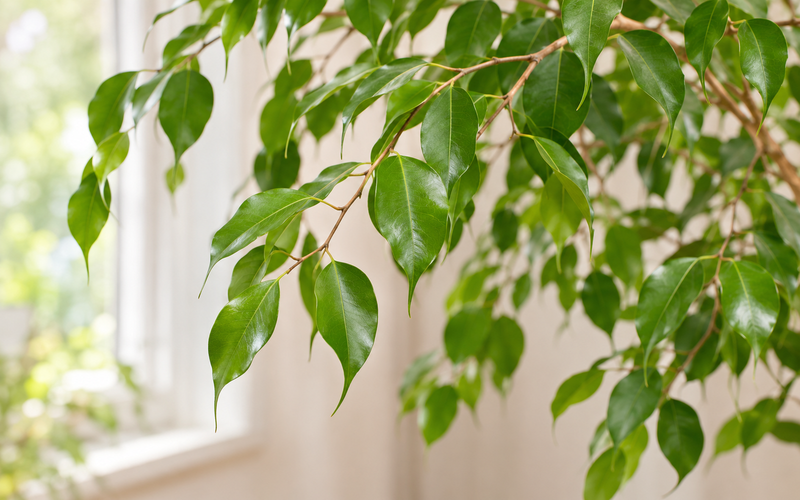
Leaf · Weeping fig
Small and pointed
Weeping fig (Ficus benjamina): small, pointed leaves on finely branched shoots.


GREEN24 Ficus Fertiliser is a liquid NPK concentrate for ficus species (indoor figs) kept indoors. Nitrogen is the largest share, phosphate the smallest. Feeding takes place during the growing season from March to September.
1 Use
1 capful · every 2–3 weeks · March to September
5 ml= 1 capful per 1 l of water
2 GREEN24 · Plant knowledge
Feeding season March to September. Growth March to October, peak May to August, rest November to February.
Leaf · Weeping fig
Weeping fig (Ficus benjamina): small, pointed leaves on finely branched shoots.
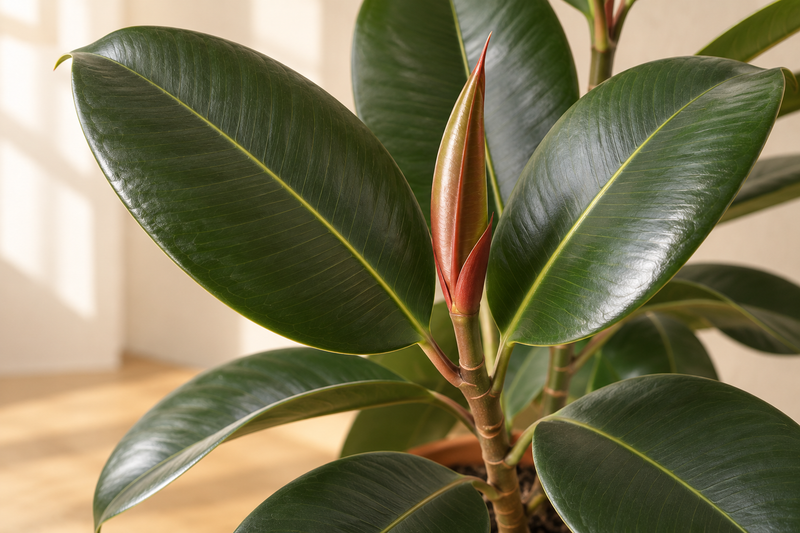
Leaf · Rubber plant
Rubber plant (Ficus elastica): broad, leathery leaves; it often grows at first with a few strong stems.
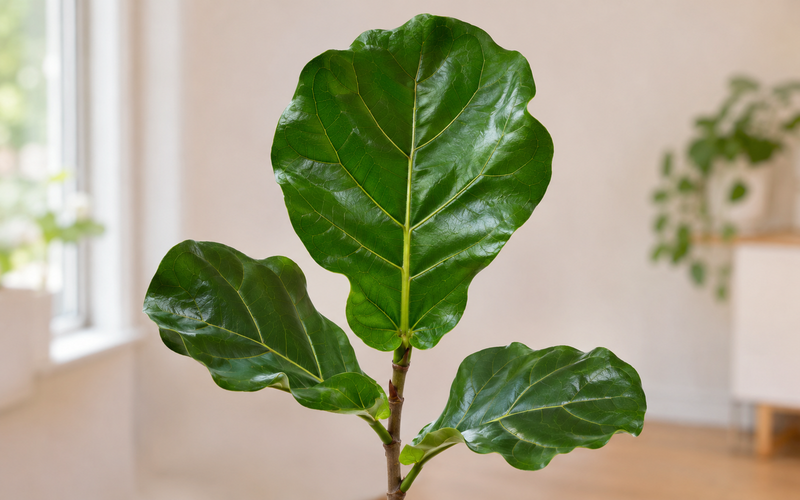
Leaf · Fiddle-leaf fig
Fiddle-leaf fig (Ficus lyrata): large, fiddle-shaped leaves; it too often grows at first with a few strong stems.
3 Nutrients
| Nutrient | Content |
|---|---|
| Total nitrogen (N) | 11.0 % |
| of which nitrate nitrogen | 0.15 % |
| of which urea nitrogen | 10.8 % |
| Water-soluble phosphate (P₂O₅) | 4.6 % |
| Water-soluble potassium oxide (K₂O) | 6.9 % |
| Boron (B) | 0.01 % |
| Copper (Cu) · EDTA chelate | 0.004 % |
| Iron (Fe) · EDTA chelate | 0.02 % |
| Manganese (Mn) · EDTA chelate | 0.012 % |
| Molybdenum (Mo) | 0.001 % |
| Zinc (Zn) · EDTA chelate | 0.004 % |
All nutrients are water-soluble, with the trace nutrients copper, iron, manganese and zinc bound as chelates. A buffer system supports the pH of the mixture; good wetting spreads the spray solution over the leaves.
4 Goes with
5 Questions and answers
Every 2–3 weeks during active growth, regularly from March to September.
5 ml. That is 5 ml (1 capful) per 1 litre of water; for a 10-litre watering can 50 ml (10 capfuls).
250 ml makes approx. 50 litres of watering solution – about 5 cans of 10 litres. Twin pack 2 × 250 ml: approx. 100 litres. 1 litre: approx. 200 litres.
Yes, for watering or spraying at the same dilution. Do not spray open flowers, do not apply in direct sunlight or below 5 °C or above 30 °C.
Preferably low-lime water or rainwater at 15–25 °C.
The regular application period ends in September. Feed only during the growing season, according to growth.
In a dry, dark place above 8 °C and at no more than 38 °C, out of reach of children and animals.
Watering · through the rootsWater ficus plants onto the pre-moistened root ball. The container needs free drainage; the root ball should be neither permanently wet nor completely dried out.
Spraying · onto the leafWet the leaves on both sides with a fine mist.
6 Knowledge
Compatibility applies to the fertiliser plus one product at a time, not to all products with each other. Observe crop, target organism, place of use, dose and waiting periods in both sets of instructions; the stricter requirement applies. Never mix undiluted concentrates with each other.
Use plant protection products safely. Always read the label and product information before use.


Dry · dark · above 8 °C to a maximum of 38 °C
Store in a dry, dark place above 8 °C and at no more than 38 °C.
Keep out of reach of children and animals.
The original leaflet supplements safe application. This product's dilution stated above remains authoritative.
GREEN24
15.95 €
5 l compost + 250 ml fertiliser
Delivery time: In stock · 1–3 days (DE)
Incl. VAT, plus shipping costs
GREEN24
From 9.85 €
( 39.40 €/ l)
Liquid feed for foliage plants such as Monstera, rubber plants and spider plants.
250 ml · 500 ml – twin pack (2 × 250 ml)
Delivery time: In stock · 1–3 days (DE)
Incl. VAT, plus shipping costs
GREEN24
From 11.95 €
( 47.80 €/ l)
Liquid concentrate · dedicated application programmes
250 ml · 500 ml – twin pack (2 × 250 ml)
Delivery time: In stock · 1–3 days (DE)
Incl. VAT, plus shipping costs
GREEN24
19.95 €
( 3.99 €/ l)
Ready-to-use nutrient solution in a 5-litre canister
5 l
Delivery time: In stock · 1–3 days (DE)
Incl. VAT, plus shipping costs

Plant species, pests, diseases and care in seconds – plus products that really fit, free of charge.


