


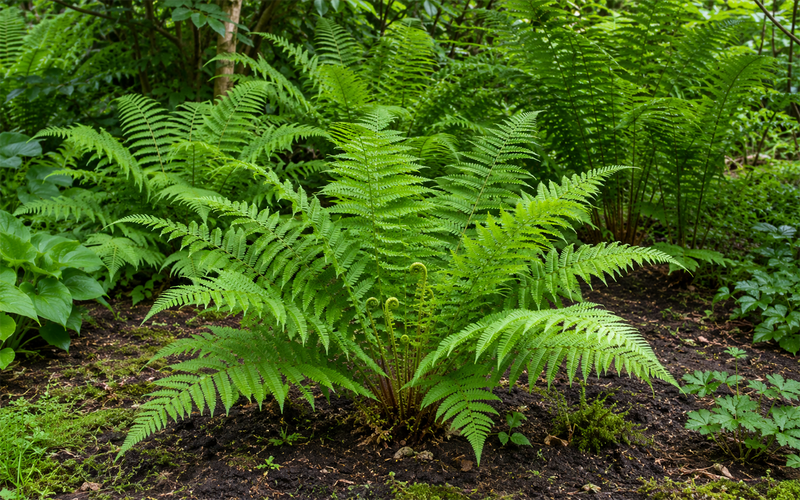
Frond
Unfolding fronds
Coiled young fronds unfold gradually. Spore clusters beneath fronds are often normal.


GREEN24 Fern Fertiliser is a liquid NPK concentrate for ferns (Dryopteris, Nephrolepis and others) indoors, in conservatories, containers and beds. Potassium is the largest share, nitrogen the smallest. Feeding takes place during the growing season from March to October.
1 Use
1 capful · every 1–2 weeks · March to October
5 ml= 1 capful per 1 l of water
2 GREEN24 · Plant knowledge
Feeding season March to October. Growth March to October, rest November to February.
Frond
Coiled young fronds unfold gradually. Spore clusters beneath fronds are often normal.
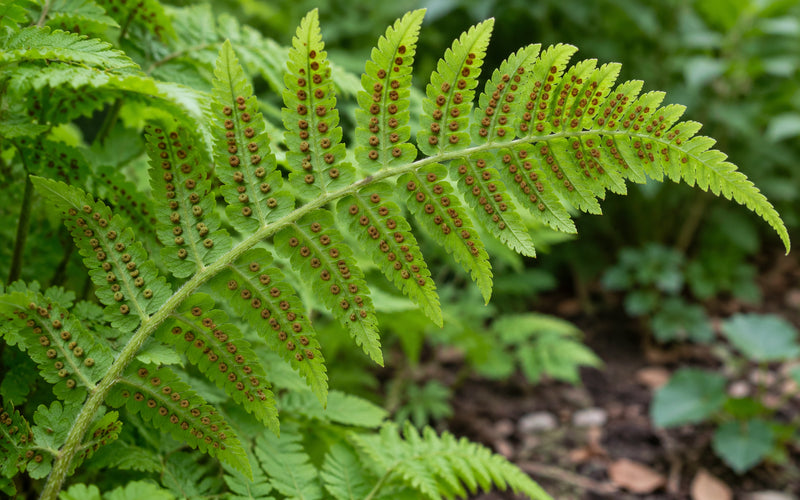
Spores
Ferns produce neither flowers nor seeds; brown spore clusters are not necessarily pests.
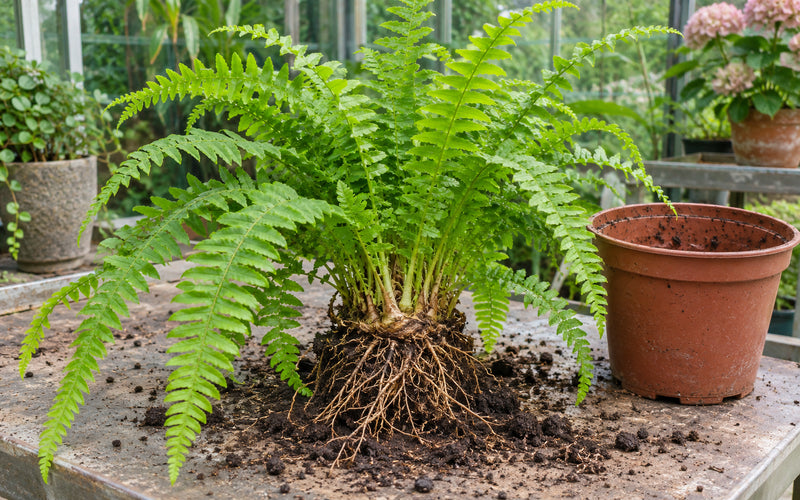
Rhizome
Depending on species, ferns form vase-shaped clumps, creeping rhizomes or arching fronds.
3 Nutrients
| Nutrient | Content |
|---|---|
| Total nitrogen (N) | 1.25 % |
| of which urea nitrogen | 1.0 % |
| Water-soluble phosphate (P₂O₅) | 2.0 % |
| Water-soluble potassium oxide (K₂O) | 3.0 % |
| Boron (B) | 0.0025 % |
| Copper (Cu) · EDTA chelate | 0.001 % |
| Iron (Fe) · EDTA chelate | 0.005 % |
| Manganese (Mn) · EDTA chelate | 0.003 % |
| Molybdenum (Mo) | 0.0003 % |
| Zinc (Zn) · EDTA chelate | 0.001 % |
All nutrients are water-soluble; the trace nutrients copper, iron, manganese and zinc are bound as chelates. A buffer system supports the pH of the mix; good wetting spreads the spray solution over the fronds.
4 Goes with
5 Questions and answers
Every 1–2 weeks during active growth, regularly from March to October.
5 ml. That is 5 ml (1 capful) per 1 litre of water; for a 10-litre watering can 50 ml (10 capfuls).
250 ml makes approx. 50 litres of watering solution – about 5 cans of 10 litres. Twin pack 2 × 250 ml: approx. 100 litres.
Yes, for watering or spraying at the same dilution. Do not spray open flowers, do not apply in direct sunlight or below 5 °C or above 30 °C.
Preferably low-lime water or rainwater at 15–25 °C.
The regular application period ends in October. Feed only during the growing season, according to growth.
In a dry, dark place above 8 °C and at no more than 38 °C, out of reach of children and animals.
Watering · through the rootsWater ferns onto the pre-moistened compost. Many ferns prefer consistent moisture, but not a permanently waterlogged pot.
Spraying · onto the leafWet the fronds with a fine mist; strong midday sun can damage delicate fronds.
6 Knowledge
Compatibility applies to the fertiliser plus one product at a time, not to all products with each other. Observe crop, target organism, place of use, dose and waiting periods in both sets of instructions; the stricter requirement applies. Never mix undiluted concentrates with each other.
Use plant protection products safely. Always read the label and product information before use.
Discover more


Official advisory recommendations take precedence.
Wash your face and hands thoroughly. Use diluted fertiliser promptly and keep it out of water bodies and wastewater.
Dry · dark · above 8 °C to a maximum of 38 °C Store in a dry, dark place above 8 °C and at no more than 38 °C. Keep out of reach of children and animals.
Keep tightly closed in the original container, separate from food and animal feed.
Dry · dark · above 8 °C to a maximum of 38 °C Store in a dry, dark place above 8 °C and at no more than 38 °C. Keep out of reach of children and animals.
Keep fertiliser residues and wash water out of waterways and sewage. Follow packaging disposal directions.
Prepare only the amount needed and never apply undiluted.
The original leaflet supplements this product’s own instructions. Use dilution stages only within their stated scope; standard dilution remains the basis of yield.

Plant species, pests, diseases and care in seconds – plus products that really fit, free of charge.


