


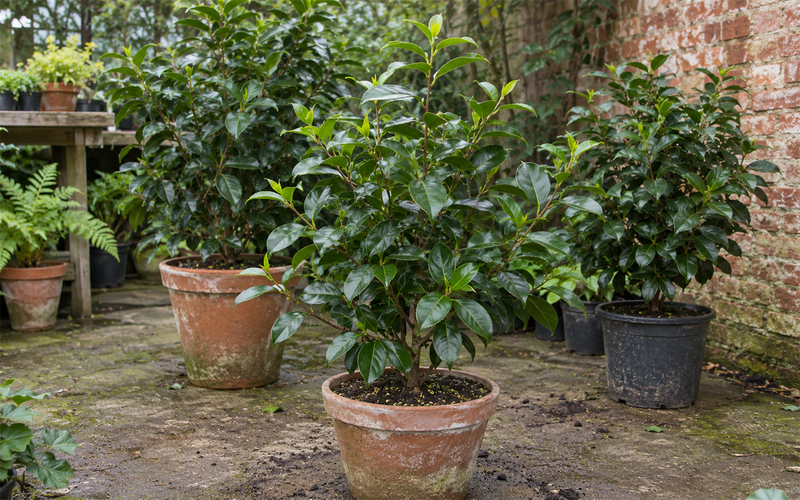
Leaf
Glossy leathery leaves
Glossy leathery leaves persist through winter. The smaller leaves of sasanqua camellia often help distinguish it.


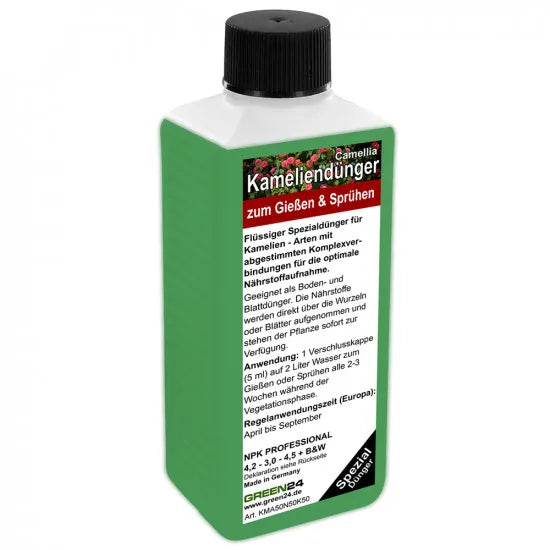
GREEN24 Camellia Fertiliser is a liquid NPK concentrate for camellias (Camellia) in beds and containers. Potassium is the largest share, phosphate the smallest. Feeding takes place during the growing season from April to September.
1 Use
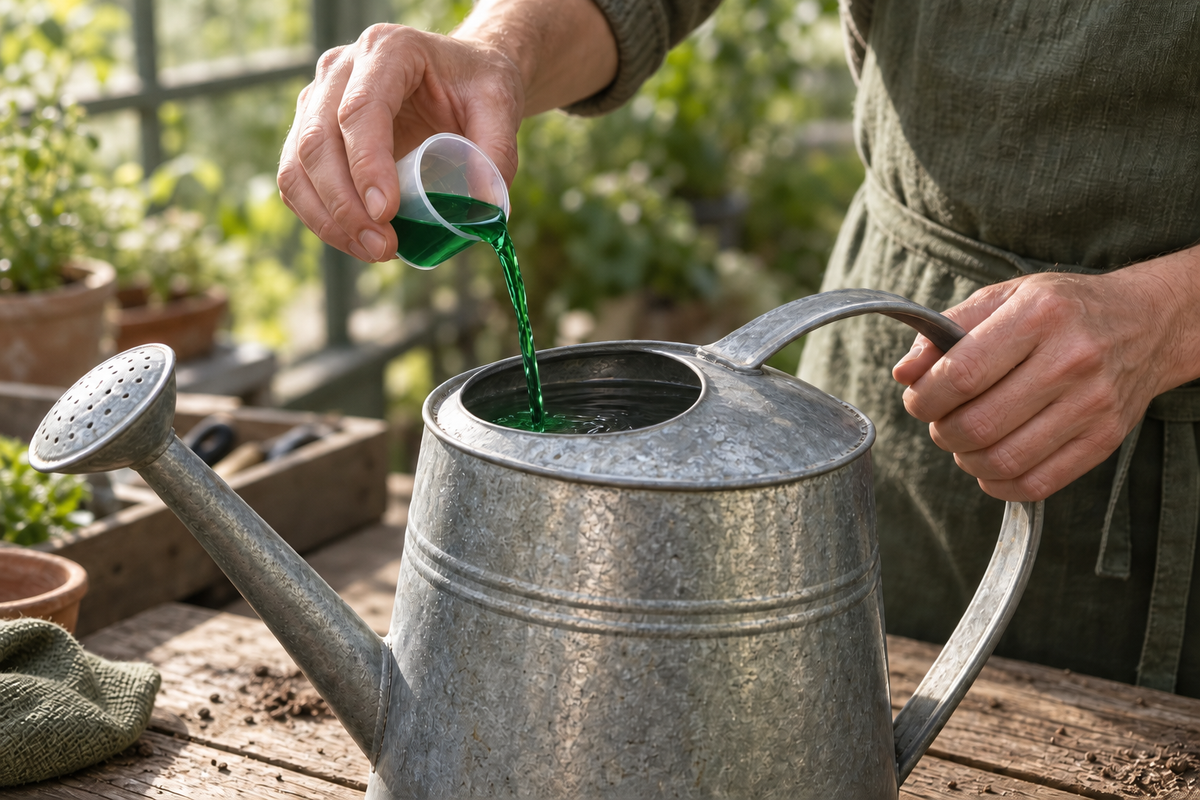
1 capful · every 2–3 weeks · April to September
5 ml= 1 capful per 2 l of water
2 GREEN24 · Plant knowledge
Feeding season April to September. Growth April to September, rest October to March.
Leaf
Glossy leathery leaves persist through winter. The smaller leaves of sasanqua camellia often help distinguish it.
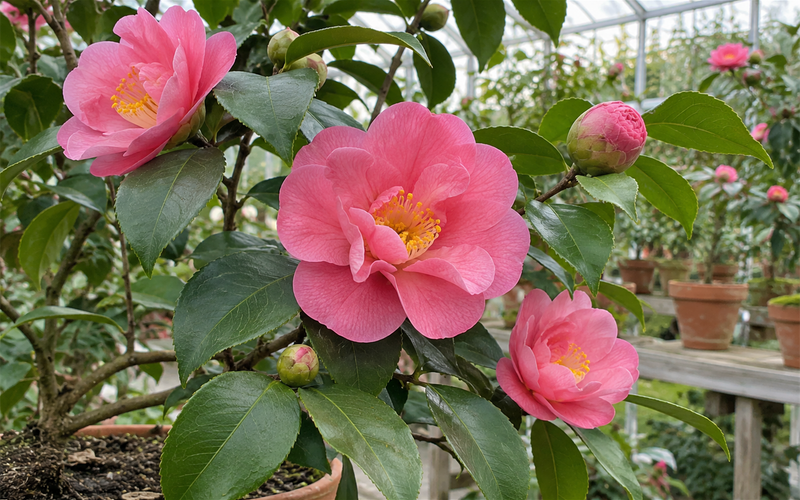
Flower
Camellia japonica mainly flowers from late winter to spring, Camellia sasanqua in autumn and winter.
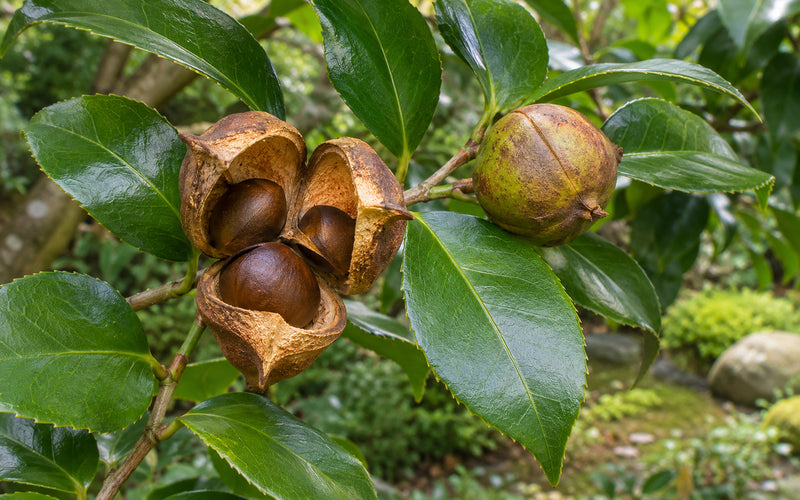
Fruit
Woody seed capsules may form after pollination; they are distinct from the flowers.
3 Nutrients
| Nutrient | Content |
|---|---|
| Total nitrogen (N) | 4.25 % |
| of which urea nitrogen | 4.0 % |
| Water-soluble phosphate (P₂O₅) | 3.0 % |
| Water-soluble potassium oxide (K₂O) | 4.5 % |
| Boron (B) | 0.005 % |
| Copper (Cu) · EDTA chelate | 0.002 % |
| Iron (Fe) · EDTA chelate | 0.01 % |
| Manganese (Mn) · EDTA chelate | 0.006 % |
| Molybdenum (Mo) | 0.0005 % |
| Zinc (Zn) · EDTA chelate | 0.002 % |
All nutrients are water-soluble; the trace nutrients copper, iron, manganese and zinc are bound as chelates. A buffer system supports the pH of the mix; good wetting spreads the spray solution over the glossy, leathery leaves.
4 Goes with
5 Questions and answers
Every 2–3 weeks during active growth, regularly from April to September.
2.5 ml. That is 5 ml (1 capful) per 2 litres of water; for a 10-litre watering can 25 ml (5 capfuls).
250 ml makes approx. 100 litres of watering solution – about 10 cans of 10 litres. Twin pack 2 × 250 ml: approx. 200 litres.
Yes, for watering or spraying at the same dilution. Do not spray open flowers, do not apply in direct sunlight or below 5 °C or above 30 °C.
Preferably low-lime water or rainwater at 15–25 °C.
The regular application period ends in September. Feed only during the growing season, according to growth.
In a dry, dark place above 8 °C and at no more than 38 °C, out of reach of children and animals.
Watering · through the rootsWater camellias around the root zone, onto pre-moistened compost. The compost should be acidic, humus-rich and free-draining; low-lime water is helpful.
Spraying · onto the leafWet the glossy, leathery leaves with a fine mist. Avoid open flowers.
6 Knowledge
Compatibility applies to the fertiliser plus one product at a time, not to all products with each other. Observe crop, target organism, place of use, dose and waiting periods in both sets of instructions; the stricter requirement applies. Never mix undiluted concentrates with each other.
Use plant protection products safely. Always read the label and product information before use.
Discover more
 FertiliserHydrangea FertiliserFor hydrangeas and flowering acid-loving plants · Liquid concentrate
 FertiliserPine FertiliserLiquid concentrate · 250 ml or twin pack
 FertiliserJerusalem Cherry FertiliserLiquid concentrate · 250 ml or twin pack
 FertiliserPrivet FertiliserLiquid concentrate · 250 ml or twin pack


Wash your face and hands thoroughly. Use diluted fertiliser promptly and keep it out of water bodies and wastewater.
Dry · dark · above 8 °C to a maximum of 38 °C
Store in a dry, dark place above 8 °C and at no more than 38 °C.
Keep out of reach of children and animals.
More products to compare and discover.
GREEN24
From 9.85 €
( 39.40 €/ l)
For the corresponding plant or group. Follow that plant’s needs and its product label.
250 ml · 500 ml – twin pack (2 × 250 ml) · 1 litre
Delivery time: In stock · 1–3 days (DE)
Incl. VAT, plus shipping costs
GREEN24
From 9.85 €
( 39.40 €/ l)
For the corresponding plant or group. Follow that plant’s needs and its product label.
250 ml · 500 ml – twin pack (2 × 250 ml) · 1 litre
Delivery time: In stock · 1–3 days (DE)
Incl. VAT, plus shipping costs

Plant species, pests, diseases and care in seconds – plus products that really fit, free of charge.


