


At a glance
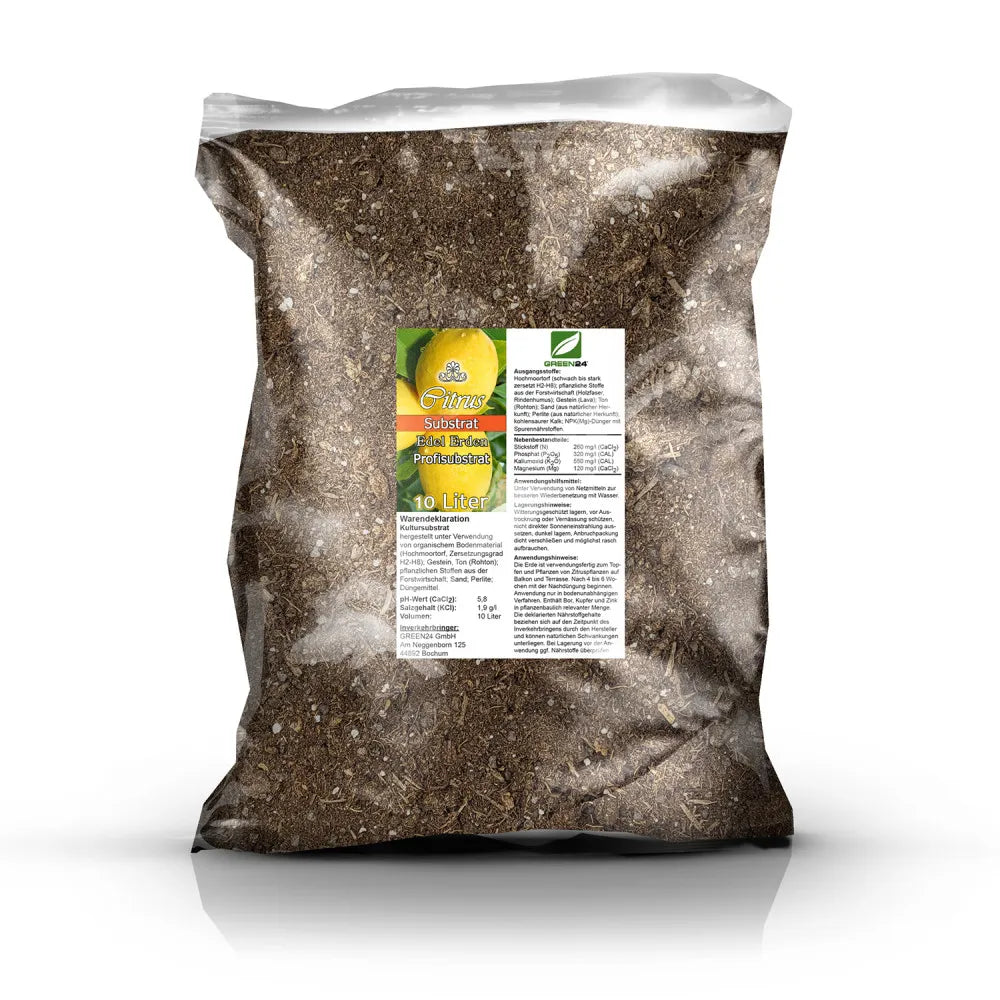
Citrus Compost
When your citrus tree needs fresh root space, this ready-to-use growing medium is intended for potting and planting citrus on balconies and patios. Each bag contains 10 litres with an initial mineral fertiliser supply.
- Use
- Citrus in containers
For potting and planting on balconies and patios.
- Bag contents
- 10 litres
Ready to use in systems independent of natural soil.
- Mix
- Peat, sand & minerals
With wood fibre, composted bark, lava, raw clay and perlite.
- Quantity prices
- Multiple bags
2–3 bags: €8.45 each · 4 or more bags: €7.95 each.
Follow the application instructions on the product label.
The declared use is limited to systems independent of natural soil, such as containers.
Easy application
When your citrus tree needs fresh root space, this ready-to-use growing medium is intended for potting and planting citrus on balconies and patios. Each bag contains 10 litres with an initial mineral fertiliser supply.
- Check the pot and root ball
The existing root ball determines the space needed. Keep the new container’s drainage holes clear.
- Keep the original depth
Add compost beneath and around the root ball, firm gently and maintain the original planting depth.
- Water and check
Moisten the root zone evenly, let excess water drain and check for settling afterwards.
The product label specifies supplementary feeding after 4 to 6 weeks. Allow for the nutrients already present, then follow the instructions of the fertiliser you choose.
Read the complete planting guideProduct information
Application & repottingReady to use for citrus plants in containers.
This growing medium is intended for potting and planting citrus on balconies and patios. Use only in systems independent of natural soil, for example containers.
The product label specifies supplementary feeding after 4 to 6 weeks. Allow for the nutrients already present, then follow the instructions of the fertiliser you choose.
PropertiesProduct characteristics and guidance
Declared ingredients are slightly to strongly decomposed raised-bog peat (H2–H8), wood fibre and composted bark from forestry, lava, raw clay, sand and perlite. Calcium carbonate and NPK(Mg) fertiliser with trace nutrients complete the mix.
Wetting agents make rewetting with water easier. The compost contains peat; fixed proportions of the individual ingredients are not stated on the label.
Declared growing-medium valuespH, salt content and nutrients with their analytical methods.
Declared nutrient contents refer to the time the manufacturer places the product on the market. They may vary naturally; check after storage before use if necessary.
- pH (CaCl₂): 5.8.
- Salt content (KCl): 1.9 g/l.
- Nitrogen (N): 260 mg/l (CaCl₂).
- Phosphate (P₂O₅): 320 mg/l (CAL).
- Potassium oxide (K₂O): 550 mg/l (CAL).
- Magnesium (Mg): 120 mg/l (CaCl₂).
- Boron, copper and zinc are present in horticulturally relevant amounts; individual quantities are not stated.
Pairs well with
Selected additions for your plant care.
-

Citrus Fertiliser
From €9,85 View productCitrus fertiliser for subsequent feeding. Follow the timing on the compost label and the fertiliser’s own dilution.
-

Mandarin Tree Fertiliser
From €9,85 View productFor subsequent feeding as needed. Account for existing nutrients in the compost.


GREEN24 · Product knowledge
About citrus compost
Fresh space for the roots
Fresh space for the roots
Citrus compost in a 10-litre bag, ready for container use. Plan the amount needed around the existing root ball.
Details & background
When your citrus tree needs fresh root space, this ready-to-use growing medium is intended for potting and planting citrus on balconies and patios. Each bag contains 10 litres with an initial mineral fertiliser supply.
When changing containers, allow for the space you actually need to fill with fresh compost. Use the mix as supplied in the bag.
Compost & root space

The mix close up
The texture photograph shows the existing growing medium. The full ingredients and declared values are collected in the product information.
Details & background
Organic and mineral ingredients form the root environment in the container. Water needs to moisten it and then drain freely. The full declaration and quantities are collected in the product information.
Repotting: the complete process
Consider the whole container
The citrus tree and its container belong together. Suitable root space, clear drainage and careful aftercare accompany repotting.
Move your citrus tree with its existing root ball. Prepare the new container and maintain the plant’s original planting depth. The eight illustrated steps take you from assessing space to aftercare.
-
Check the need and timing
Look for roots filling the pot densely, growing through drainage holes or a growing medium that needs replacing. Yellow leaves alone do not establish a need to repot.
Where possible, schedule routine repotting near the start of active growth. Have compost, a new container, a watering can and a protective mat ready; avoid leaving the roots exposed unnecessarily.
-
Choose a suitable container
Choose the pot for the existing root ball. If more root space is needed, select a moderately larger diameter. Around 20% more diameter is a general guide, not a compulsory size.
Check the space beneath and around the root ball and the height available for a watering rim. A universal minimum size of 30 or 40 litres would not take small citrus plants into account.
-
Prepare drainage and the base
Check that all drainage holes are clear. In the illustrated setup, neither coarse drainage material nor water-permeable filter fleece may obstruct the outlet.
Such a separating layer does not guarantee protection from waterlogging. Clear outlets, suitable compost and appropriate watering remain essential. A decorative outer pot needs a plant pot with its own drainage.
-
Ease out the root ball
Support the root ball and loosen the old container by tapping or gently squeezing it. Do not force the tree out by pulling on its stem.
Preserve healthy roots as far as possible. Severely damaged, rotten or dead areas need separate assessment; substantial root pruning is not an automatic part of every repotting.
-
Set the compost bed and planting depth
Add some compost beneath the root ball and place it on this bed. Adjust the amount underneath until the original root-ball surface sits below the container rim.
Keep the root collar and any graft union uncovered. Do not plant deeper than before; leave space at the top for watering.
-
Fill the sides and firm lightly
Hold the tree in position and add compost around the root ball. Work in layers and press with your hand only enough to close larger gaps.
Do not compact it hard. Maintain the original root-ball surface and an even watering rim; do not heap compost against the stem.
-
Water the new root zone
Apply water slowly and evenly to the surface. It should reach the fresh compost around the root ball and be able to drain out of the base.
Observe drainage and adjust the amount to the moisture level. If water simply spills over the upper edge, check the rim and surface first.
-
Check settling and plan aftercare
After drainage, check whether the compost has settled. Carefully fill small hollows, maintain planting depth and watering space, and water lightly again only if needed.
Empty the saucer or outer pot. Check root-ball moisture before further watering. Record the repotting date; the label specifies supplementary feeding after 4–6 weeks.
Citrus care in the plant catalogue Application and subsequent feeding
Continue attentive care after repotting
Watch root-ball moisture
After repotting, the old root ball and fresh compost may hold different levels of moisture. Check the root zone before watering again.
Keep drainage clear
Remove standing water from the saucer or outer pot. Sand and mineral ingredients cannot compensate for a blocked drainage hole.
Start feeding appropriately
Plan further nutrient supply using the label guidance and the plant’s growth. Dilute the linked citrus fertiliser separately according to its own instructions.
Understand changes in your tree
Pale leaves, leaf drop or slow growth can have different causes. Check growing conditions, watering and roots before adding more fertiliser or repotting again. This growing medium is not a plant protection product and does not promise to cure existing damage.
Questions about citrus compost
Is this citrus compost ready to use?
Yes. The label describes a prepared mix for potting and planting citrus. No fixed addition of sand or fertiliser is specified for its declared application.
Does this compost contain peat?
Yes. Raised-bog peat with a decomposition grade of H2–H8 is a declared ingredient. Other ingredients include wood fibre, composted bark, sand, lava, raw clay and perlite.
How much compost will repotting need?
The bag contains 10 litres. The amount needed depends on the free space beneath and around the existing root ball, which already occupies part of the new container. Tree height alone is not enough to calculate it.
How do I account for the initial fertiliser?
The mix already contains NPK(Mg) fertiliser and trace nutrients. The label specifies starting supplementary feeding after 4–6 weeks; follow the fertiliser you select for further application.
Can I work this compost into garden soil?
The label limits use to systems independent of natural soil. A container on a balcony or patio is one such use. This does not establish suitability for mixing into garden ground.
Will the mix prevent yellow leaves?
Suitable compost is part of care, but it does not guarantee a constant leaf colour. Moisture, light, roots and possible pests must also be considered.
Learn more about your citrus plant
Which citrus plant are you growing?
Citrus includes different species and cultivars. Container conditions and winter quarters belong in an individual care plan.
Look at care through the year
Repotting, watering and feeding work together. The plant profile helps you consider the location, care calendar and common changes as a whole.
Safety and storage
Safety instructions
Wash your face and hands thoroughly. Use diluted fertiliser promptly and keep it out of water bodies and wastewater.
Product GPSR safety information
Storage
Please follow the product-specific information on the label and in the full description.
Read the full product description →Manufacturer / company placing the product on the market
GREEN24 GmbH
Am Neggenborn 125
44892 Bochum, Germany
info@green24.de
www.green24.de