


Schädlings-Frei-Organic
€16,95
For spraying or watering, depending on the authorised use. The method depends on the plant, pest and location.
View product in our shop →

Look for roots filling the pot densely, growing through drainage holes or a growing medium that needs replacing. Yellow leaves alone do not establish a need to repot. Where possible, schedule routine repotting near the start of active growth. Have compost, a new container, a watering can and a protective mat ready; avoid leaving the roots exposed unnecessarily.
Choose the pot for the existing root ball. If more root space is needed, select a moderately larger diameter. Around 20% more diameter is a general guide, not a compulsory size. Check the space beneath and around the root ball and the height available for a watering rim. A universal minimum size of 30 or 40 litres would not take small citrus plants into account.
Check that all drainage holes are clear. Neither coarse drainage material nor water-permeable filter fleece may obstruct the outlet. Such a separating layer does not guarantee protection from waterlogging. Clear outlets, suitable compost and appropriate watering remain essential. A decorative outer pot needs a plant pot with its own drainage.
Support the root ball and loosen the old container by tapping or gently squeezing it. Do not force the tree out by pulling on its stem. Preserve healthy roots as far as possible. Severely damaged, rotten or dead areas need separate assessment; substantial root pruning is not an automatic part of every repotting.
Add some compost beneath the root ball and place it on this bed. Adjust the amount underneath until the original root-ball surface sits below the container rim. Keep the root collar and any graft union uncovered. Do not plant deeper than before; leave space at the top for watering.
Hold the tree in position and add compost around the root ball. Work in layers and press with your hand only enough to close larger gaps. Do not compact it hard. Maintain the original root-ball surface and an even watering rim; do not heap compost against the stem.
Apply water slowly and evenly to the surface. It should reach the fresh compost around the root ball and be able to drain out of the base. Observe drainage and adjust the amount to the moisture level. If water simply spills over the upper edge, check the rim and surface first.
After drainage, check whether the compost has settled. Carefully fill small hollows, maintain planting depth and watering space, and water lightly again only if needed. Empty the saucer or outer pot. Check root-ball moisture before further watering. Record the repotting date; the label specifies supplementary feeding after 4–6 weeks.
5 ml per 2.5 l of water.
Every 1–2 weeks during the growing season.
Regular application period: April–September.
| Water | Standard 100 % | Young plants 50 % | Seedlings with leaves 20 % |
|---|---|---|---|
| 1 l | 2 ml | 1 ml | 0.4 ml |
| 5 l | 10 ml | 5 ml | 2 ml |
| 10 l | 20 ml | 10 ml | 4 ml |
Shake the concentrate before use.
Pour the required amount of water into a suitable container.
Use standard 100%, young plants 50%, or seedlings with leaves 20% of the basic dilution. Concentration does not determine the watering volume needed.
Measure the calculated amount accurately with a suitable measuring aid.
Add the concentrate to the water and mix evenly.
Feed the already moist root ball when nutrients are needed; do not overwater using a rigid water volume.
Do not mix the entire bottle into the bag. The compost is ready to use; dilute the concentrate separately with water.
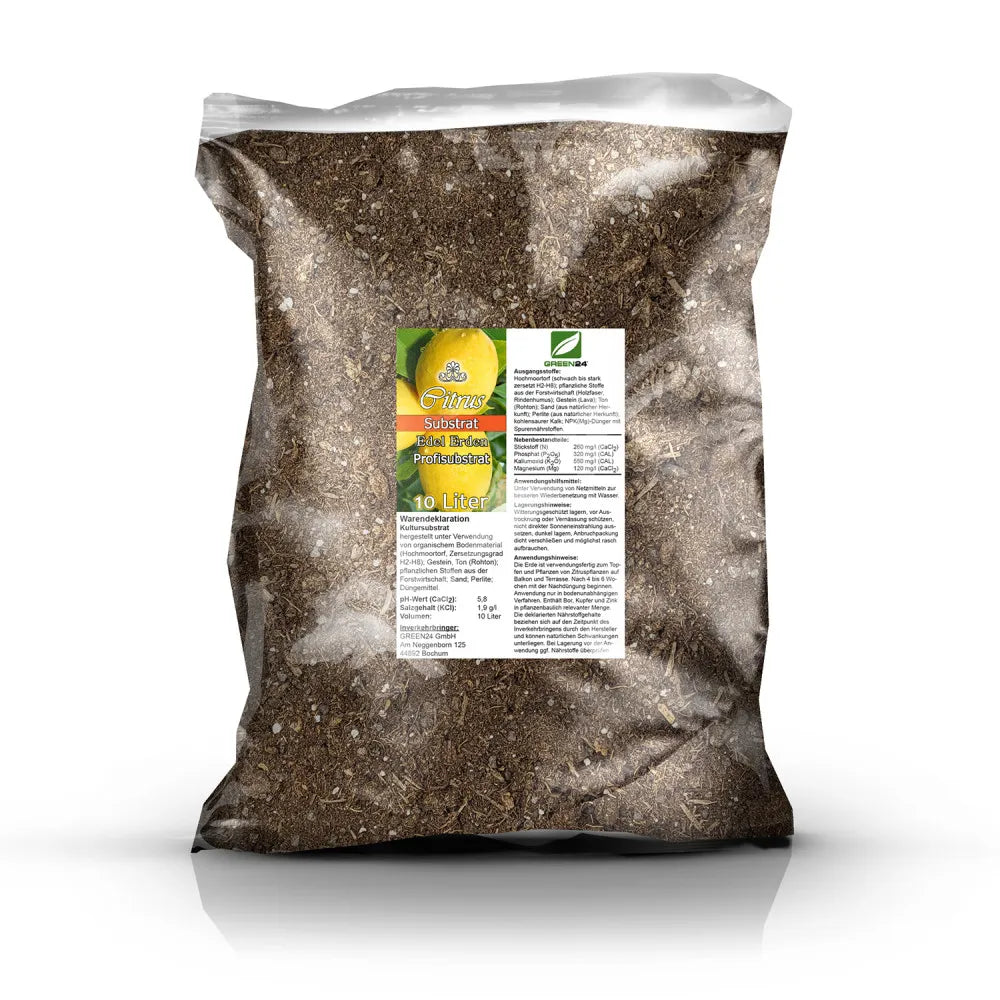
Citrus Repotting Set: 10 litres of ready-to-use repotting compost and 250 ml liquid concentrate for later feeding according to need.
The product label specifies supplementary feeding after 4 to 6 weeks. Allow for the nutrients already present, then follow the instructions of the fertiliser you choose.
NPK 5.1 + 2.5 + 3.7
Declared nutrient percentages. Product pH: 6.8.
An organic base with sand and mineral ingredients.
Declared ingredients are slightly to strongly decomposed raised-bog peat (H2–H8), wood fibre and composted bark from forestry, lava, raw clay, sand and perlite. Calcium carbonate and NPK(Mg) fertiliser with trace nutrients complete the mix.
Wetting agents make rewetting with water easier. The compost contains peat; fixed proportions of the individual ingredients are not stated on the label.
pH, salt content and nutrients with their analytical methods.
Declared nutrient contents refer to the time the manufacturer places the product on the market. They may vary naturally; check after storage before use if necessary.
Included: one 10-litre bag of compost and one 250 ml bottle of fertiliser. Plant and pot are not included.
Provide bright conditions and free drainage. During cool overwintering, match feeding to actual growth.
Ready to use for citrus plants in containers.
This growing medium is intended for potting and planting citrus on balconies and patios. Use only in systems independent of natural soil, for example containers.
The product label specifies supplementary feeding after 4 to 6 weeks. Allow for the nutrients already present, then follow the instructions of the fertiliser you choose.
Dry · dark · above 8 °C to a maximum of 38 °C
Store in a dry, dark place above 8 °C and at no more than 38 °C.
Keep out of reach of children and pets. Clean your hands after working with compost.
Keep dark, sheltered from the weather and tightly sealed.
Protect from drying out or waterlogging and keep out of direct sunlight.
Seal opened bags tightly and use the contents as soon as possible.
One 10-litre bag of compost and one 250 ml bottle of fertiliser. Plant and container are not included.
The product label specifies supplementary feeding after 4 to 6 weeks. Allow for the nutrients already present, then follow the instructions of the fertiliser you choose.
5 ml per 2.5 litres of water. The table shows standard, young-plant and leafy-seedling strengths.
At standard dilution, approximately 125 litres of feed solution. Match watering volume to the plant.
No. Use the ready-to-use compost and dilute the concentrate separately with water for later feeding.

Citrus Repotting Set: 10 litres of ready-to-use repotting compost and 250 ml liquid concentrate for later feeding according to need.
The product label specifies supplementary feeding after 4 to 6 weeks. Allow for the nutrients already present, then follow the instructions of the fertiliser you choose.
5 ml per 2.5 litres of water. Account for the initial nutrients in the compost.
The plant species, photographs and details of location, moisture and previous care help assess plant damage. Identify the cause and a suitable application before treatment.
More fertiliser is not a general solution to growing problems. A recommendation to buy products together does not confirm that they can be mixed.
General manufacturer information: these products have not been selected here as suitable treatments for the plant shown here. Before use, check the plant species, pest, application site and current instructions.


Use plant protection products safely. Always read the label and product information before use.
Selected additions for your plant care.

Buy the included fertiliser separately.

Buy the included compost separately.
