


GREEN24
Orchid Potting Mix · Choice of Grade
For an airy root zone for potted orchids
- With conifer bark and coir fibre for potted orchids
- Choose FK, MK or GK to suit your orchid
- Ready to use for careful repotting
 5 litres / FK · fine (0–15 mm)
Couldn't load pickup availability
Item details

At a glance
Orchid Potting Mix · Choice of Grade
Ready-to-use bark/coir mix for potting and repotting orchids; use only independently of natural ground soil.
- Use
- Potted orchids
Match the grade to roots, pot and care.
- Pack sizes
- 4, 5 or 10 litres
4 litres available as FK; 5 and 10 litres available as FK, MK and GK.
- Structure
- Fine · medium · coarse
Choose between three particle-size ranges.
- Application
- Ready to use
Repot carefully and retain air spaces.
Let root condition and moisture needs guide the choice.
Easy application
For rooted orchids in suitable containers. The illustrated sequence explains loose potting of epiphytic container orchids.
- Select the grade
Assess root thickness, pot size and moisture requirements together.
- Keep space around roots
Gently remove broken-down medium and distribute fresh mix loosely.
- Adjust aftercare
Check moisture and root condition after repotting; keep the outer pot free of standing water.
The bag label gives 2 to 3 weeks as the starting point for supplementary feeding. Match actual feeding to active growth and root recovery.
View the illustrated repotting guideProduct information
ApplicationReady to use · select grade for roots and growing conditions
The mix is intended for potting and repotting orchids; the label specifies use only in cultivation separate from natural ground soil. Watering, pot size and grade work together; the orchid genus alone does not determine the choice.
Its own bag label gives 2 to 3 weeks before starting suitable supplementary feeding. Assess the need first for dormant or damaged plants.
PropertiesProduct characteristics and guidance
FK fine: approximately 0–15 mm. MK medium: approximately 0–35 mm. GK coarse: approximately 0–50 mm. Bag size does not change the grade.
The mix contains bark pieces and fibres. Fill loosely to retain air spaces. The ranges describe approximate particle sizes.
The 4-litre pack is available as FK · fine (0–15 mm).
Ingredients & growing-medium valuesOwn bag declaration for all seven variants
The following values match on the original 4-litre bag and the original FK, MK and GK bags in 5 and 10 litres. Declared values apply when placed on the market and may vary naturally. The medium’s pH does not guarantee the later pH of irrigation water.
- Ingredients: 90% plant materials from forestry (conifer bark), plant materials from agriculture (coir fibre).
- Organic matter: 50%.
- pH (CaCl₂): 5.0.
- Nitrogen N (CaCl₂), phosphate P₂O₅ (CAL) and potassium oxide K₂O (CAL): each below the declaration threshold of 50 mg/l.
- Salt content: below the declaration threshold of 0.5 g/l.
Original German label 5 L · FK Opens in a new window.
Original German label 5 L · MK Opens in a new window.
Original German label 5 L · GK Opens in a new window.
Original German label 10 L · FK Opens in a new window.
Original German label 10 L · MK Opens in a new window.


GREEN24 · Substrate knowledge
Give orchid roots a suitable loose medium
Ready-to-use bark/coir mix for potting and repotting orchids; use only independently of natural ground soil.

Support the root system
Gently remove broken-down bark; do not tear off firmly attached pieces.

Protect fleshy roots
Preserve firm pale or silvery roots; do not prune based on colour alone.

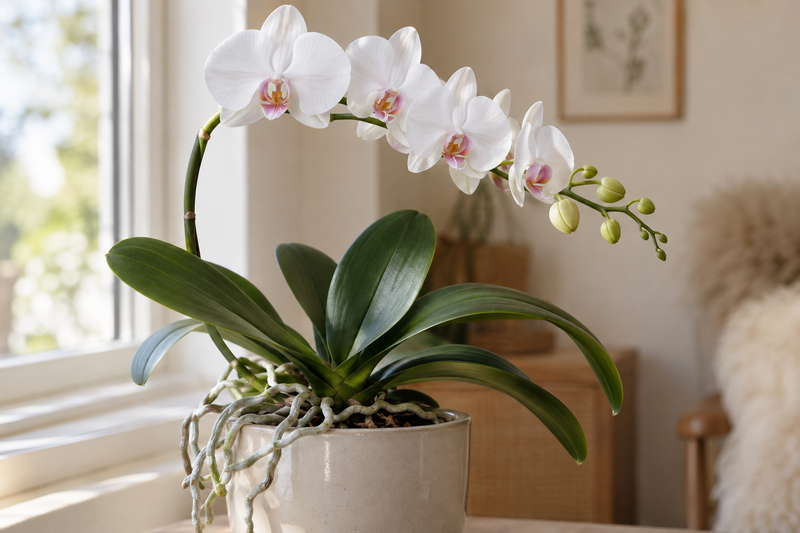
Phalaenopsis as a growing example
Keep the leaf bases and crown above the mix; do not force aerial roots into the pot.
Pairs well with
Selected additions for your plant care.
-
GREEN24
Premium Orchid Fertiliser
From 9.85 €
( 39.40 €/ l)
For later feeding according to its own label; account for initial nutrients in the medium.
250 ml · 500 ml – twin pack (2 × 250 ml) · 1 litre
Delivery time: In stock · 1–3 days (DE)
Incl. VAT, plus shipping costs
-
GREEN24
Transparent orchid pots – three sizes and four pack options
From 3.95 €
( 0.79 €/ item)
Transparent pots for suitable orchids; match size to the root ball and ensure drainage.
11.4 cm / 5 pots · 11.4 cm / 10 pots · 11.4 cm / 20 pots · +9
Delivery time: In stock · 1–3 days (DE)
Incl. VAT, plus shipping costs
-
Dr. Stähler
Dr. Stähler yellow sticky plant traps – pack of 12
4.95 €
( 0.41 €/ item)
Sticky traps for monitoring flying insects on potted plants; do not reach larvae in the medium.
Delivery time: 3–5 days (DE)
Incl. VAT, plus shipping costs
-
BERGER
BERGER 5610 narrow planting trowel
9.95 €
Narrow planting trowel for filling medium; protect roots while working.
Delivery time: In stock · 1–3 days (DE)
Incl. VAT, plus shipping costs


The actual growing-medium texture
The original close-up shows the selected grade FK fine, approximately 0–15 mm.
Choose grade, roots, pot size and watering together. Bag volume alone does not change the grade.
Practical guide
Repotting in eight steps
For rooted epiphytic potted orchids. These steps are not a universal guide for all terrestrial orchids.
- 1
Check timing and root condition
Repot when the mix has broken down, stays wet too long or leaves healthy roots no room. New root tips are a useful sign for establishment. Aerial roots outside the pot alone do not mean repotting is necessary.
- 2
Choose a suitable pot
Select a clean container with open drainage holes that just accommodates the roots. A much larger pot holds unnecessary wet medium. A clear pot makes Phalaenopsis root checks easier.
- 3
Prepare medium and tools
Have the selected grade, clean scissors and a work surface ready. Moisten dry bark mix evenly before filling. Clear drainage holes are needed; this sequence does not add a separate gravel or clay-pebble layer.
- 4
Gently remove the old mix
Loosen the pot and support the plant around its roots. Ease decomposed bark out of the spaces; do not tear off firmly attached pieces. If necessary, cut the old plastic pot rather than break healthy roots.
- 5
Assess roots and preserve healthy ones
Use clean tools to remove soft, rotten or hollow dead roots. Keep firm roots, including pale or silvery ones. Do not cut by colour alone, and protect new root tips.
- 6
Hold the plant at the right level
Keep the leaf bases and crown of Phalaenopsis above the medium. On orchids with rhizomes and pseudobulbs, leave these exposed and allow room for the next growth. Do not force outward-growing aerial roots into the pot.
- 7
Fill loosely and stabilise
Work small amounts of fresh mix between the roots. Tap the pot gently to fill large spaces without packing tightly. The plant should stand securely; support it carefully if needed until new roots anchor it.
- 8
Monitor moisture and recovery
Keep in bright light protected from strong direct sun. Time the first watering to root injuries, initial medium moisture and the species’ needs. Let subsequent watering drain fully; remove water from the outer pot and leaf axils. Resume feeding only when appropriate to growth.
The mix’s own label specifies supplementary feeding after 2–3 weeks with a suitable fertiliser. Account for growth and root condition.

Get to know orchids
Choose a position and care suited to the plant.
Read more
Nutrition after repotting
Follow the medium’s own declaration and adjust further feeding.
Read moreQuick answers before you buy (FAQ)
Which grades are available in the 4-litre pack?
The 4-litre pack is FK fine, approximately 0–15 mm. The 5- and 10-litre packs also offer MK medium, approximately 0–35 mm, and GK coarse, approximately 0–50 mm.
Is this ordinary potting compost or a bark mix?
The declaration lists 90% plant materials from forestry (conifer bark), plus coir fibre from agriculture. The original photographs show the different bark textures.
Can I use the mix directly for repotting?
Yes. The label describes a ready-to-use growing medium for potting and repotting orchids. It is intended for cultivation independent of natural ground soil.
Does “below 50 mg/l” mean it contains no nutrients?
No. The label states that nitrogen, phosphate and potassium oxide are each below the declaration threshold of 50 mg/l; that does not mean zero content.
When does this mix’s label say to begin supplementary feeding?
Its own label specifies 2–3 weeks and a suitable fertiliser. Account for growth and root condition and follow the fertiliser’s dosage.
Does a larger pack change the grade or declared pH?
Grade is selected by FK, MK or GK, rather than by bag volume. All seven checked original bags state pH 5.0 (CaCl₂).
How should I store leftover bark mix?
Reseal tightly, store in a dark place sheltered from weather and use promptly. Protect from drying out, excessive wetness and direct sunlight.
Safety and storage
Safety instructions
Avoid bending brittle roots or flower spikes. Use scissors carefully; do not routinely shorten healthy roots. Do not leave water standing in the crown.
- Wear gloves, cover open wounds and wash hands with soap and water afterwards. Growing media may contain microorganisms.
- Avoid dust and ventilate well. Take extra care with sensitive airways or allergies to mould and soil ingredients; use suitable respiratory protection when needed.
- Avoid eye contact. If compost enters the eyes, rinse with water. Seek medical advice if symptoms persist.
- Not for consumption. Keep out of reach of children and pets and separate from food and animal feed. If accidentally swallowed, seek medical advice and have product information available.
- Transport bags closed and move heavy containers with assistance. Clear spilled compost to prevent slipping.
- Dispose of residues and packaging according to local rules. Do not put into drains or release uncontrolled into the environment.
Storage
Sheltered and dark · use opened bags promptly
Store in a dark place protected from weather. Protect from drying out, excessive wetness and direct sunlight; reseal opened bags tightly and use promptly.
Manufacturer / company placing the product on the market
GREEN24 GmbH
Am Neggenborn 125
44892 Bochum, Germany
info@green24.de
www.green24.de
Similar products
More products to compare and discover.
-
GREEN24
Orchid Repotting Set MK
16.95 €
Alternative repotting set with medium and fertiliser; already includes feed. Not additionally needed alongside the same individual product.
10 l compost + 250 ml fertiliser
Delivery time: In stock · 1–3 days (DE)
Incl. VAT, plus shipping costs
-
GREEN24
Orchid Growing-On Medium AK
From 8.95 €
( 1.79 €/ l)
Growing-on mix for suitable young potted orchids; check grade and water needs separately.
5 litres · 10 litres
Delivery time: In stock · 1–3 days (DE)
Incl. VAT, plus shipping costs
-
GREEN24
Transparent orchid pots – three sizes and four pack options
From 3.95 €
( 0.79 €/ item)
Transparent pots for suitable orchids; match size to the root ball and ensure drainage.
11.4 cm / 5 pots · 11.4 cm / 10 pots · 11.4 cm / 20 pots · +9
Delivery time: In stock · 1–3 days (DE)
Incl. VAT, plus shipping costs
-
GREEN24
Perlite 2–6 mm
0.95 €
( 0.95 €/ l)
Individual component for planned blends; not a ready-to-use replacement for orchid medium.
1 litre
Delivery time: In stock · 1–3 days (DE)
Incl. VAT, plus shipping costs


Plant sick? Identify a plant? Take a photo – GREEN24AI helps right away.
Plant species, pests, diseases and care in seconds – plus products that really fit, free of charge.