

Water-soluble & available
All nutrients are water-soluble. In the fully diluted mixture, they are available for feeding through roots and leaves.


Start simply · explore when you want
Plumeria develops thick, water-storing shoots with leaves towards their tips. Start with the application guide, then explore container care from rooting to flowering and winter rest.
For frangipani in the genus Plumeria. Species and cultivar affect leaf fall, growth habit and flowering; not every plant keeps its leaves in winter.
During active growth, normally March–October. Consider current growth, root condition and nutrients already present.
After repotting, allow for fertiliser already in the compost. Unrooted cuttings and plants with soft, damaged roots first need appropriate rooting or care conditions.
Application in one place
Enter the amount of water you need, or use the height and crown width of one Plumeria as a rough root-watering guide. The calculator uses this fertiliser’s standard dilution.
1 capful = 5 ml. Use a suitable measuring aid for smaller partial amounts.
Enter a water amount from 0.1 to 1,000 litres.
A rough root-watering guide for one Plumeria only, not a foliar spray volume. Measure height from the growing-medium surface and the whole crown width, not an individual leaf. Check pot volume, root-ball moisture, rooting and growth stage; do not force the suggested amount. Do not use this guide during leafless dormancy.
General GREEN24 guide: height (m) × width (m) × 3–4 litres. Centimetres are converted to metres. The concentrate amount follows this fertiliser’s standard dilution. The estimate does not measure individual water requirements.
Use a clean watering can or sprayer; preferably low-lime water or rainwater at 15–25 °C.
Enter the water volume. If using the size-based guide, also check root-ball moisture, root space and active growth.
Start by filling the container with part of the chosen water volume.
Shake the bottle. 1 capful = 5 ml; use a measuring aid for smaller partial amounts.
Add the calculated amount of concentrate to the water.
Top up to the chosen water volume and mix well. Watering or spraying: see below.
When to feed? Every 1–2 weeks during active growth, normally March to October. Water as needed between feeds. Allow for nutrients already present; do not continue feeding by the calendar during dormancy.
Pre-moisten the root zone and distribute the mixture evenly over the growing medium. Excess water must be able to drain from the pot. If shoots are soft or the root ball is waterlogged, investigate root conditions first.
Lightly wet the existing leaf surfaces in the morning, evening or overcast conditions, keeping open frangipani flowers dry. Foliar feeding belongs to the same feeding plan as root application. Do not spray bare shoots as a substitute when the plant is leafless.
Original label net mass: 319 g for 250 ml.
At the label watering dilution, 250 ml of concentrate makes 125 l of prepared fertiliser solution.
| Pack size | Price |
|---|---|
| 250 ml | €9,85 EUR |
| 500 ml – twin pack (2 × 250 ml) | €18,95 EUR |
Declared nutrient percentages. Product pH: 6.2.
Pre-fertilised soil and fertiliser already in the root ball contribute to the nutrient supply. Each of the four care products listed below can be mixed with our liquid fertiliser. When applying them together, follow both products’ specific instructions; conflicting or stricter directions take precedence. Do not mix undiluted concentrates.
Our frangipani fertiliser is individually compatible with Schädlings-Frei Organic, Trauermückenfrei Organic, KIRON Milben-Ex or Rosen Pilz-Frei BOCCACIO. This confirmation applies to the fertiliser mixed with one of these products at a time. Follow the specific instructions and stricter conditions of both products.
Request the compatibility table →Beyond NPK · understand the formulation
Water-soluble nutrients and coordinated formulation properties support Plumeria nutrition. Apply the prepared mixture to the root zone or to existing leaves.
All nutrients are water-soluble. In the fully diluted mixture, they are available for feeding through roots and leaves.
Copper, iron, manganese and zinc are declared as EDTA chelates. This binding helps keep these trace nutrients available in solution.
The buffer system helps regulate the pH of the finished watering or spraying solution. The source water also influences the resulting value.
Good wetting and adherence help distribute the spray solution across the leaves. Dissolved nutrients are then available at the leaf surface for uptake.
The formulation helps reduce adverse hard-water effects and deposits on the leaves. Low-lime water or rainwater provides a good starting point.
Good plant tolerance under suitable application conditions supports leaf, shoot and flower development. It does not turn a dormant or unrooted Plumeria into an actively growing plant.
Appropriate nutrition supports leaf formation and green foliage. Leaf finish describes a well-maintained appearance, not a sprayed-on shine. Flowering and scent also depend on species, cultivar, maturity and position; a particular flower count is not promised.
Chelation binds metal ions and can reduce disruptive effects of water hardness; it does not remove calcium or magnesium from the water. The product pH of 6.2 describes the concentrate. The pH of the prepared mixture also depends on the source water; no fixed target value is promised.
Use clean, suitable watering or spraying equipment. Measure the water and calculated concentrate quantity carefully.


Growing frangipani in a container
New leaves develop on the thick shoots during active growth. Flower clusters appear near shoot tips and reflect the diversity of Plumeria species and cultivars. Observe this development alongside light, warmth and root condition.
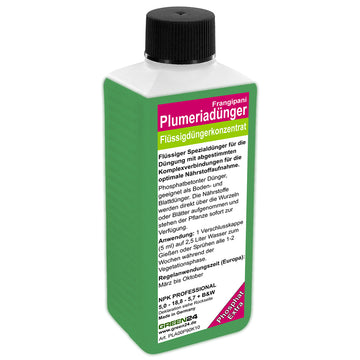
The concentrate supplements Plumeria’s mineral nutrition during active growth. A bright summer position and suitable winter accommodation are equally important. New leaves and buds can be observed, but cannot be forced by a stronger mixture.
Leaf surfaces use light to supply sugars for new tissues. Shape and leaf retention vary by species and cultivar. If leaves fall in autumn, consider dormancy before increasing fertiliser.
A flower cluster can carry buds, open flowers and fading blooms at the same time. Development depends on species, maturity and growing conditions. Keep open flowers dry during foliar application.
New leaves and flower clusters develop at shoot tips. Plan pruning around space and plant condition rather than routinely removing all tips. Protect fragile branches when moving or repotting.

A suitable container and sheltered position allow the branching habit to develop. Leave room for the crown and plan bright, frost-free winter accommodation.
From the root zone to fresh shoots
Roots take up water and dissolved nutrients from the growing medium. Leaves use light to produce sugars for growth and maintenance. Thick shoots store water and connect roots, leaves and flowers. Nitrogen supports protein and chlorophyll formation; phosphorus participates in energy transfer and potassium in water regulation. Nutrition supports flower development but cannot replace adequate light or the appropriate growth phase.
Absorbing roots need moisture and oxygen. A free-draining medium and open drainage help provide both. An unrooted cutting does not yet have that uptake system and is not fed like an established plant.
Vascular tissue connects the roots with the crown. Plumeria shoots are vulnerable to breakage and prolonged wet conditions. Water reserves in the shoots do not replace healthy roots; soft, dark tissue calls for diagnosis rather than extra fertiliser.
Leaves are concentrated towards the shoot tips. With enough light they provide sugars for new tissues. Nitrogen and trace nutrients participate in their metabolic functions. A sparse or leafless dormant period is part of the cycle in deciduous species such as Plumeria rubra.
The phosphate-rich formulation supplements mineral nutrition during growth. Phosphorus is one of the nutrients involved in energy transfer and tissue formation; adding more does not automatically trigger flowering. Pruning time and retained shoot tips also affect flower development.
Understanding plant feeding
Plumerias carry most leaves at the ends of thick, water-storing stems. During leafy growth, the roots take up nutrients from the free-draining root ball. Existing leaves can also absorb a fully diluted nutrient solution. A leafless rest period is not a reason for extra feeding; species and actual leaf retention determine care.
Select a point in the picture or choose a stage.
Stage 01 / 04
Distribute the diluted mixture through the previously moistened root zone. The free-draining root ball should wet the fine roots while allowing excess solution to drain away.
Good to knowThick plumeria stems store water. This does not mean the root ball should remain permanently wet.
The first step is contact between dissolved nutrients and root regions capable of uptake. The diagram shows this function, not a species-specific tissue section. Thick plumeria stems store water. This does not mean the root ball should remain permanently wet.
Stage 02 / 04
Fine root regions make contact with the growing medium. Dissolved nutrients enter root cells through regulated uptake processes.
Good to knowAn unrooted stem cutting does not yet have the working root system of an established container plant.
Root hairs increase the contact area. Transport across cell membranes is distinct from water movement alone. An unrooted stem cutting does not yet have the working root system of an established container plant.
Stage 03 / 04
Cell membranes and transport proteins regulate uptake. The plant does not simply absorb all the fertiliser together with irrigation water.
Good to knowInvestigate soft stems or rotting roots first; additional fertiliser does not correct rot.
Controlled processes within living root cells lie between the surface and the conducting tissue. Functional blocks do not depict the entire root anatomy. Investigate soft stems or rotting roots first; additional fertiliser does not correct rot.
Stage 04 / 04
Water and absorbed nutrients can move through the xylem to above-ground plant parts. Supply also depends on the plumeria's actual growth.
Good to knowDo not try to force a leafless, dormant plumeria into growth with extra nutrients.
Xylem transports water and dissolved substances. Root health and growing conditions also influence uptake and onward movement. Do not try to force a leafless, dormant plumeria into growth with extra nutrients.
Stage 01 / 04
Spray the fully diluted mixture onto existing leaf surfaces. Avoid the waxy flowers; bare dormant stems are not a substitute for leaves.
Good to knowFoliar and root applications belong to one feeding plan, not two added full doses.
The leaf surface must contact the diluted solution. Wetting is the first step, not evidence that nutrients have already been absorbed. Foliar and root applications belong to one feeding plan, not two added full doses.
Stage 02 / 04
The surface of the elongated plumeria leaf limits exchange. Dissolved nutrients can cross this barrier; leaf condition and application conditions influence uptake.
Good to knowA glossy surface is not a reason to increase concentration or spray more frequently.
Nutrients can cross the protective cuticle; routes through stomata may also contribute. Their contribution depends on species and conditions. A glossy surface is not a reason to increase concentration or spray more frequently.
Stage 03 / 04
Nutrients that have crossed the surface can be taken up by living leaf cells. These cells contribute to metabolism and the formation of growing plant tissue.
Good to knowLeaf fall in dormant Plumeria rubra does not automatically indicate nutrient deficiency.
After crossing the surface, nutrients can be taken up by living leaf cells. Quantity also depends on the nutrient and surrounding conditions. Leaf fall in dormant Plumeria rubra does not automatically indicate nutrient deficiency.
Stage 04 / 04
Some absorbed nutrients are used within the leaf. Redistribution depends on the nutrient and plant condition; it cannot force branching or flowering.
Good to knowLight, maturity, species and retained shoot tips remain important for flowering.
Whether and how far nutrients move from a leaf to other parts varies among nutrients. Immediate supply to the whole plant cannot be inferred. Light, maturity, species and retained shoot tips remain important for flowering.
Development influences requirements
A cutting must form roots first. For rooted young plants, check roots, growing medium and existing fertiliser before starting regular feeding. Extra fertiliser cannot compensate for missing roots.
Feed at the stated interval during active growth. A bright, warm position supports development. Flowering may be delayed after pruning; a low bud count alone does not justify stronger dilution.
Plumeria rubra may lose its leaves in winter, while some other species can remain leafy in warmth. Match watering to actual growth and root-ball moisture, and do not feed during dormancy. Leaf fall alone does not establish a nutrient deficiency.
Consider species, rooting, growth stage and existing nutrients together. Height alone determines neither a different dilution nor individual water requirements.
Application & calculator →Your growing conditions matter
In cooler climates, frangipani is grown with protection in containers. Plan its summer position and winter accommodation together. Coordinate light, warmth and drainage; do not treat it as a hardy garden perennial.
Choose a container with open drainage and a free-draining growing medium. During leafy growth, water according to root-ball moisture and let excess water drain away. Thick shoots store water but do not protect roots from rot in constantly wet media.
Acclimatise gradually to stronger sun after winter. A warm, sheltered outdoor position can suit the plant in appropriate weather. Bring it inside before cold conditions and protect its fragile shoots during handling.
Overwinter in a bright, frost-free place, with warmth matched to species and growing conditions. Water leafless Plumeria rubra very sparingly during dormancy. Check root-ball moisture on leafy plants and inspect regularly for spider mites, mealybugs or scale.
Check root space and growing medium at the start of growth and repot when needed. Protect healthy roots and brittle shoots. Fertiliser already in fresh compost counts towards nutrition; repotting does not automatically call for an extra feed.
Plumeria and Adenium growing medium or the Plumeria repotting set support the next pot change. Choose the volume you need and account for its existing fertiliser.

A matching growing medium for the next repotting. Allow for the nutrients already included when planning further feeding.

The Plumeria repotting set combines 5 or 10 litres of growing medium with 250 ml of this fertiliser. It is an alternative to buying separately; allow for existing supplies and pre-fertilisation.
Understand plant care problems
Leaf fall, soft shoot tips and leaf spots have different causes. Check the season, light, warmth and root-ball moisture. Leaf fall can be part of dormancy in Plumeria rubra; soft, dark tissue requires closer examination.
Check pale stippling, dull leaves and fine webbing, especially in warm indoor conditions. Inspect leaf undersides and separate affected plants from others.
Inspect leaf axils and shoots for cottony deposits, fixed scales or sticky honeydew. Watch newly purchased plants particularly closely.
Soft dark tips, a yielding stem or rotten roots are warning signs. Cool wet conditions encourage rot. Check drainage, temperature and affected tissues; do not add extra feed.
Yellowish spots above and orange spore pustules beneath a leaf may indicate rust. Remove affected and fallen leaves rather than simply adding feed; confirm uncertain symptoms.
Autumn leaf fall can be part of dormancy in P. rubra. During growth, also check light, temperature, watering and roots. Lack of flowers may reflect youth, cultivar or recent pruning.
These details help assess growing conditions, root problems or a possible infestation:
Leaf colour alone identifies neither a nutrient deficiency nor the amount of feed needed. Targeted soil or leaf analysis may help with unclear damage. Identify the cause before choosing a plant-protection treatment.
These four plant-care products are individually compatible with our frangipani liquid fertiliser.
Dr. Stähler
€16,95
Insect control: check the pest, plant species and authorised application site.
Mixable with GREEN24 liquid fertilisersView product & applicationDr. Stähler
€9,99
For fungus gnat larvae: follow the authorised crop and watering application.
Mixable with GREEN24 liquid fertilisersView product & applicationDr. Stähler
€12,95
Mite control: identify the infestation and follow the authorised application.
Mixable with GREEN24 liquid fertilisersView product & applicationDr. Stähler
€13,95
Fungal control: check the disease, plant species and authorised growing situation.
Mixable with GREEN24 liquid fertilisersView product & applicationMixability applies to fertiliser plus one product at a time, not to all products mixed together. Follow crop, pest, application site, dose, waiting periods and the stricter requirements of both sets of instructions. Do not mix undiluted concentrates.
Use plant protection products safely. Always read the label and product information before use.
For frangipani in the genus Plumeria. Species and cultivar affect leaf fall, growth habit and flowering; not every plant keeps its leaves in winter.
Dilution: 5 ml per 2.5 l of water.
Measure out the concentrate and mix it with the stated amount of water. Never apply undiluted.
Calculated yield at standard dilution: 250 ml makes 125 litres, and 2 × 250 ml makes 250 litres of nutrient solution.
Do not apply in sunlight, below 5 °C or above 30 °C. Never apply the concentrate undiluted.
SDS – Safety data sheet available on request.
Avoid contact with eyes, skin and clothing. Do not inhale spray mist. Wear protective clothing, rubber gloves and safety glasses when handling the product. Keep away from food and beverages. Wash your face and hands thoroughly after use. Official advisory recommendations take precedence. Fertilisers may leave permanent stains on surfaces. Do not allow fertiliser to enter bodies of water or wastewater.
Wash your face and hands thoroughly. Use diluted fertiliser promptly and keep it out of water bodies and wastewater.
Store in a dry, dark place above +8 °C and no higher than +38 °C. Keep out of reach of children and animals.
Keep tightly closed in the original container, separate from food and animal feed.
Avoid large temperature fluctuations. Temperature-related discolouration or crystals may occur; the crystals dissolve by the dilution stage at the latest and do not impair product quality. For this fertiliser, store dry and dark above 8 °C and at no more than 38 °C. Use diluted fertiliser promptly.
Do not allow fertiliser residues or rinsing water to enter waterways or wastewater. Follow the disposal instructions on the packaging.
Measure concentrate accurately and apply only after dilution. More fertiliser does not compensate for insufficient light, drought or damaged roots.
See the product documents for safe mixing and application. Use the dilution for this frangipani concentrate and account for root and foliar applications together.
More products to compare and discover.

Compare within the range: Olive Tree Fertiliser.

Compare within the range: Banana Fertiliser.


