


Schädlings-Frei-Organic
€16,95
For spraying or watering, depending on the authorised use. The method depends on the plant, pest and location.
View product in our shop →

First establish your plants’ light, moisture and soil-reaction needs. This compost is intended for suitable dry-site species; acid-loving or consistently moisture-dependent specialists may need a different growing medium. Where possible, repot during a suitable growth period. Spring or early autumn suit many hardy species, but the particular plant remains the guide.
Choose a container with clear drainage holes and sufficient root space. The fresh compost required is the space beside and beneath the root ball, not simply a function of plant height. Allow for the eventual spread of cushions and rosettes. Leave enough space so vigorous neighbours do not cover slow-growing plants.
These eight steps cover repotting into a container. If drainage material or water-permeable fleece is used, it must not block the drainage holes. An extra layer does not guarantee protection against waterlogging. Position the trough so water can drain freely; do not leave standing water in a closed outer pot.
Loosen the old pot carefully and support the root ball. Do not pull on flower stalks, shoot tips or individual rosettes. Preserve healthy roots where possible. Assess severely damaged or rotting roots separately; routine root cutting is not a general step for every rock garden plant.
Add enough compost and place the root ball. Retain its original surface level; do not bury rosette centres, shoot bases or sensitive crowns more deeply. Leave a little room below the rim for watering. Decorative stones must not crush the plant or make the root ball unstable.
Work the compost gently around the root ball and close larger gaps by firming lightly. Do not compact it hard. If adding a mineral top-dressing, keep living plant parts clear. Top-dressing changes neither the required planting depth nor the species’ water needs.
For newly planted, intact root balls, water the fresh compost carefully and let excess water drain. Choose timing and amount for the species and root condition. Do not flood every species indiscriminately or let every plant dry out completely afterwards. For sensitive, injured succulent roots, follow that plant’s specific guidance.
After watering, correct small settled areas without burying plant bases. Check free drainage and stability. Check moisture more frequently during establishment. The compost already has declared nutrients; plan further feeding according to actual need.
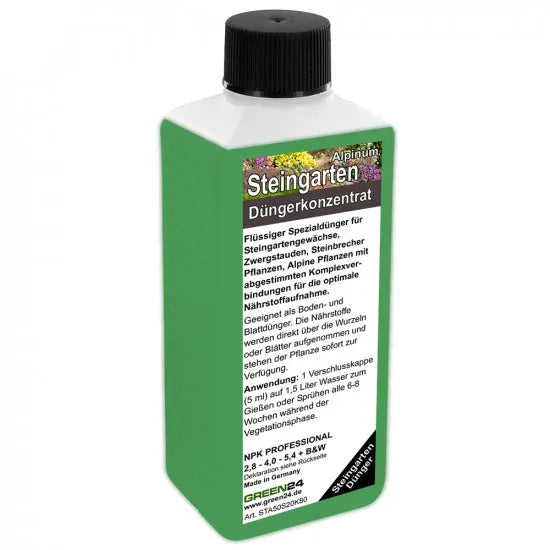
Shake well before use. One capful equals 5 ml according to the label. Never apply undiluted; official advisory recommendations take precedence.
| Water | Standard 100 % | Young plants 50 % | Seedlings with leaves 20 % |
|---|---|---|---|
| 1 l | 3.33 ml | 1.67 ml | 0.67 ml |
| 5 l | 16.67 ml | 8.33 ml | 3.33 ml |
| 10 l | 33.33 ml | 16.67 ml | 6.67 ml |
Shake the concentrate before use.
Pour the required amount of water into a suitable container.
Use standard 100%, young plants 50%, or seedlings with leaves 20% of the basic dilution. Concentration does not determine the watering volume needed.
Measure the calculated amount accurately with a suitable measuring aid.
Add the concentrate to the water and mix evenly.
Feed the already moist root ball when nutrients are needed; do not overwater using a rigid water volume.
Do not mix the entire bottle into the bag. The compost is ready to use; dilute the concentrate separately with water.
Rock Garden Repotting Set: 10 litres of ready-to-use repotting compost and 250 ml liquid concentrate for later feeding according to need.
For suitable dry-site rock garden plants.
NPK 2.8 + 4.0 + 5.4
Product pH: 6.5. This describes the concentrate, not the resulting soil pH.
Rock material, organic ingredients and clay.
The mix contains rock material, slightly to strongly decomposed raised-bog peat (H3–H8), plant materials from landscaping and forestry, raw clay and calcium carbonate.
The compost contains peat. Individual rock types are not itemised on the label. Growing-medium structure and drainage at the planting site work together; mineral-rich compost still needs a free outlet.
Label composition, pH, salt and nutrients.
Nutrient contents apply when the manufacturer places the product on the market and may vary naturally. After storage, check nutrients before use if necessary.
Included: one 10-litre bag of compost and one 250 ml bottle of fertiliser. Plant and pot are not included.
Plant profile and care calendar
Determine suitability by species and location. Drought-tolerant Sedum, Sempervivum and suitable Saxifraga species do not all need generous feeding.
For suitable dry-site rock garden plants.
A specialist mix for extensive planting sites and dry-site rock garden plants. The label gives Sedum, Sempervivum and Saxifraga as examples. Suitability within those genera still depends on the particular species and position.
The label gives no fixed starting date for further feeding. Check species-specific needs and existing nutrients before adding fertiliser. Nutrient checks may be needed after storage; an automatic feed immediately after planting is not specified.
Dry and dark · above 8°C to no more than 38°C
Store in a dry, dark place above 8°C and at no more than 38°C. Keep out of reach of children and animals.
Keep out of reach of children and pets. Not for consumption.
Avoid creating dust when filling containers. Wash your hands after use.
Store sheltered from weather and direct sun.
Store sheltered from the weather and protect from drying out, waterlogging and direct sunlight.
Seal opened bags tightly and use the contents as soon as possible.
GREEN24 GmbH
Am Neggenborn 125
44892 Bochum
Germany
Original set image Opens in a new window.
General original leaflet 130405 (PDF, German) Opens in a new window.
Original label (German) Opens in a new window.
Original label (English) Opens in a new window.
Original compost image Opens in a new window.
General leaflet 140222 – soils & growing media (PDF, German) Opens in a new window.
One 10-litre bag of compost and one 250 ml bottle of fertiliser. Plant and container are not included.
For suitable dry-site rock garden plants.
5 ml per 1.5 litres of water. The table shows standard, young-plant and leafy-seedling strengths.
At standard dilution, approximately 75 litres of feed solution. Match watering volume to the plant.
No. Use the ready-to-use compost and dilute the concentrate separately with water for later feeding.
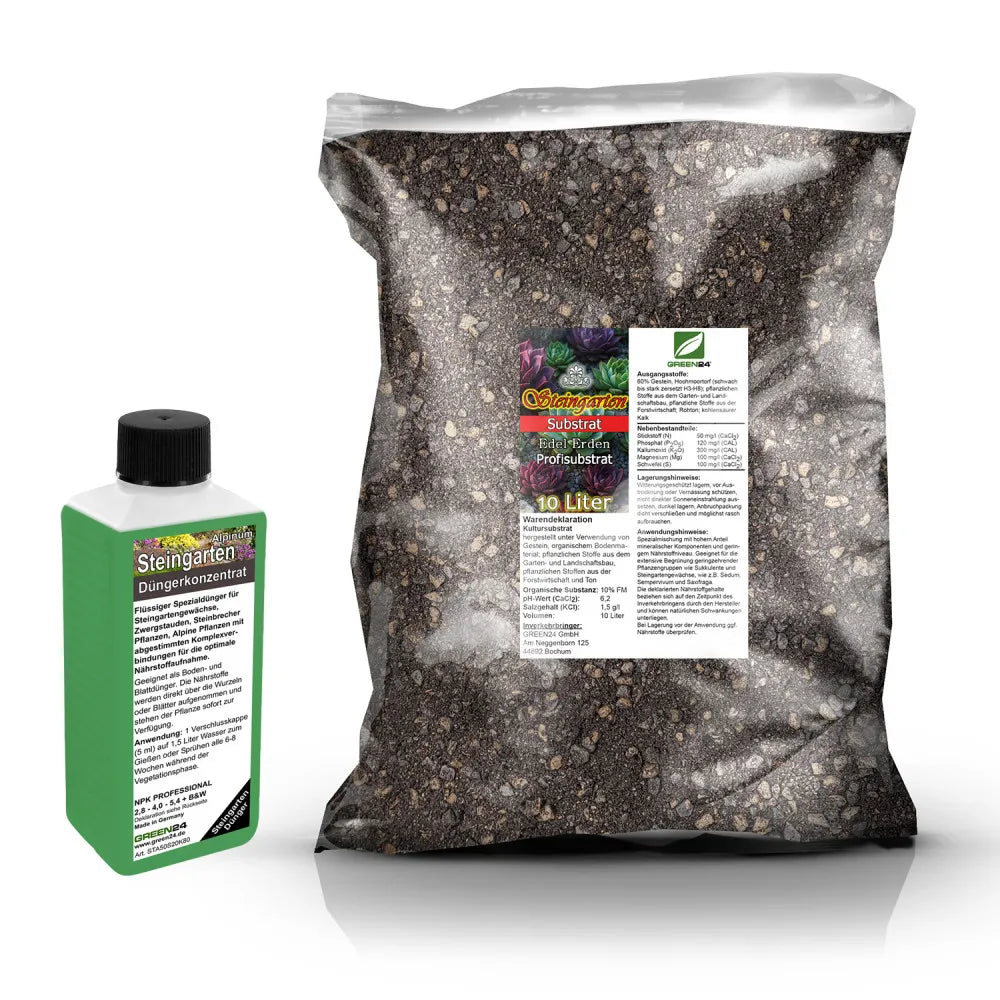
Rock Garden Repotting Set: 10 litres of ready-to-use repotting compost and 250 ml liquid concentrate for later feeding according to need.
For suitable dry-site rock garden plants.
5 ml per 1.5 litres of water. Account for the initial nutrients in the compost.
The plant species, photographs and details of location, moisture and previous care help assess plant damage. Identify the cause and a suitable application before treatment.
More fertiliser is not a general solution to growing problems. A recommendation to buy products together does not confirm that they can be mixed.
General manufacturer information: these products have not been selected here as suitable treatments for the plant shown here. Before use, check the plant species, pest, application site and current instructions.


Use plant protection products safely. Always read the label and product information before use.
Selected additions for your plant care.

Buy the included fertiliser separately.

Buy the included compost separately.
