


Schädlings-Frei-Organic
€16,95
For spraying or watering, depending on the authorised use. The method depends on the plant, pest and location.
View product in our shop →


Feed through the water
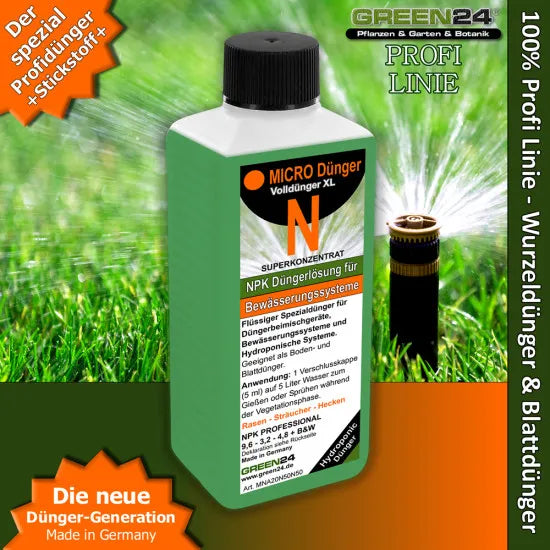
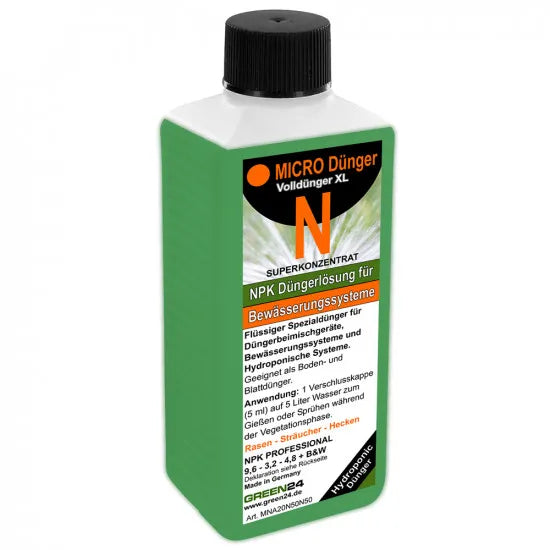
For feeding lawns, shrubs and hedges during active growth: Micro+N is a nitrogen-rich liquid concentrate with phosphate, potassium and trace nutrients. Apply with watering, as a foliar feed or through suitable irrigation systems. Standard dilution: 1 ml per litre of water.
1 ml per litre of water is the standard dilution. The reverse label gives a crop-dependent range of 1–2 ml/L. Choose the concentration for the crop and existing nutrient supply; 2 ml/L is not a universal recommendation. Feed every 1–2 weeks during active growth as needed, usually April to August for garden plants.
Set the system to the intended final concentration according to its own instructions. Water flow and the amount of concentrate drawn in must be known. Example at 1 ml/L: a system delivering 100 litres of water in 10 minutes needs 100 ml of concentrate in total. This does not define a universal pump setting. If flow data are missing, measure them first in a trial run with plain water.
Assess existing nutrients, root-zone moisture and actual growth before feeding. Soil-grown plants and closed hydroponic systems have different requirements. In hydroponics, consider water quality, crop and system management; the product label alone does not provide a complete nutrient-solution programme.
1 ml per litre of water is the standard dilution. The reverse label gives a crop-dependent range of 1–2 ml/L. Choose the concentration for the crop and existing nutrient supply; 2 ml/L is not a universal recommendation. Feed every 1–2 weeks during active growth as needed, usually April to August for garden plants.
Enter a water quantity greater than zero.
This range follows the label dilution. It does not determine which concentration is suitable for your individual plant. Follow the application instructions.
1 ml per litre of water is the standard dilution. The reverse label gives a crop-dependent range of 1–2 ml/L. Choose the concentration for the crop and existing nutrient supply; 2 ml/L is not a universal recommendation. Feed every 1–2 weeks during active growth as needed, usually April to August for garden plants.
Set the system to the intended final concentration according to its own instructions. Water flow and the amount of concentrate drawn in must be known. Example at 1 ml/L: a system delivering 100 litres of water in 10 minutes needs 100 ml of concentrate in total. This does not define a universal pump setting. If flow data are missing, measure them first in a trial run with plain water.
Net mass: 286 g per 250 ml and 1144 g per litre. The twin pack contains two 250 ml bottles. These are net contents, not shipping weights.
Declared percentages by mass. Product pH: 6.8.
Using products as part of the same care routine is different from mixing them in one container. Follow the labels and application instructions of all products involved.
The recommendations cover products for different care tasks. Combining them in the same solution requires the instructions for both products to allow that combination. Otherwise, apply the products separately.


 Enlarge image ↗
A defined purpose
For feeding lawns, shrubs and hedges during active growth: Micro+N is a nitrogen-rich liquid concentrate with phosphate, potassium and trace nutrients. Apply with watering, as a foliar feed or through suitable irrigation systems. Standard dilution: 1 ml per litre of water.
 Enlarge image ↗
Match dose and flow
Set the system to the intended final concentration according to its own instructions. Water flow and the amount of concentrate drawn in must be known. Example at 1 ml/L: a system delivering 100 litres of water in 10 minutes needs 100 ml of concentrate in total. This does not define a universal pump setting. If flow data are missing, measure them first in a trial run with plain water.
Calculate the fertiliser amount →Check plant demand and existing nutrition. Standard 1 ml/L; use the label range up to 2 ml/L only according to the crop.
Measure watering volume. For automatic injection, establish flow and run time according to the equipment instructions.
Shake the bottle. At standard dilution, measure 5 ml concentrate for 5 litres of water.
For manual mixing, start with water and stir in the concentrate. With an injection system, check dosing against the actual water throughput.
Apply the prepared solution to the pre-moistened root zone or wet the foliage. Avoid open flowers.
Include the amount applied in total nutrition. Plan another application after 1–2 weeks according to crop and growth.
 Enlarge image ↗
Roots and foliage
1 ml per litre of water is the standard dilution. The reverse label gives a crop-dependent range of 1–2 ml/L. Choose the concentration for the crop and existing nutrient supply; 2 ml/L is not a universal recommendation. Feed every 1–2 weeks during active growth as needed, usually April to August for garden plants.
Understanding plant feeding
Through the roots or through the leaves: explore four steps to discover how a plant takes up and uses nutrients.
Select a point in the picture or choose a stage.
Stage 01 / 04
Dilute the fertiliser with water according to the label. Watering carries this nutrient solution into the soil or growing medium around the roots.
Good to knowAlways dilute the concentrate and keep to the stated dosage.
Watering carries dissolved nutrients into the growing medium around the roots. Contact with the absorbing root surfaces is the first step.
Stage 02 / 04
Fine root hairs increase contact with the growing medium. Tiny transport proteins in the membranes surrounding root cells help dissolved nutrients enter the cells.
Good to knowRoots take up nutrients; they do not simply absorb all the fertiliser along with the water.
Root hairs increase the contact area. Transport proteins in cell membranes enable mineral ions to enter; water movement and nutrient uptake are distinct processes.
Stage 03 / 04
On their way into the root, nutrients meet a special layer of cells. It prevents substances from simply flowing through the gaps between cells and helps the plant control uptake.
Good to knowMore fertiliser does not automatically mean better nutrition.
Nutrients move through the root tissues. The endodermis acts as a control layer: its barrier interrupts unrestricted movement along the cell walls.
Stage 04 / 04
Inside the root are fine transport channels called xylem. Water and absorbed nutrients can travel through them towards shoots and leaves.
Good to knowHealthy roots and suitable growing conditions are important for nutrient supply.
After entering the vascular tissue, nutrients can travel with the water stream in the xylem towards the shoot. Uptake and nutrient supply also depend on root health and growing conditions.
View original diagram ↗GREEN24 diagram with German labels
Stage 01 / 04
For foliar feeding, diluted nutrient solution is sprayed onto the leaves. The product instructions tell you whether it is suitable for this use and how much to apply.
Good to knowSpray only as directed by the product instructions, never with undiluted concentrate.
Foliar feeding places diluted nutrient solution on the leaf surface. Wetting depends on factors including the leaf surface and the solution.
Stage 02 / 04
The leaf surface protects the plant. Dissolved nutrients can pass through this layer; tiny openings in the leaf may also play a part. Uptake varies with the type of leaf and the conditions.
Good to knowDifferent leaves do not absorb a nutrient solution equally well.
Dissolved nutrients can pass through the protective cuticle; pathways involving stomata may also contribute. Their relative importance varies with plant species and conditions.
Stage 03 / 04
Behind the surface lies living leaf tissue. Its cells can take up nutrients that have crossed the surface and use them for their activities.
Good to knowA droplet on a leaf does not yet mean its nutrients have been absorbed.
After crossing the surface, nutrients can be taken up by living leaf cells. The amount depends on factors including the nutrient, formulation and environmental conditions.
Stage 04 / 04
The plant can use absorbed nutrients within the leaf. Some can also reach other plant parts. This depends on the nutrient and the plant's condition.
Good to knowFoliar feeding does not mean every nutrient immediately reaches the whole plant.
Absorbed nutrients can be used within the leaf. Whether and how far they move to other plant parts depends on the nutrient and the plant's condition.
View original diagram ↗GREEN24 diagram with German labels

Nutrition and care
Assess existing nutrients, root-zone moisture and actual growth before feeding. Soil-grown plants and closed hydroponic systems have different requirements. In hydroponics, consider water quality, crop and system management; the product label alone does not provide a complete nutrient-solution programme.
View the plant group →Frequently asked questions
The standard is 1 ml per litre of water: 5 ml for 5 litres or 10 ml for 10 litres. Depending on the crop, the label range extends to 2 ml/L.
At 1 ml/L, 250 ml treats 250 litres of water, the twin pack treats 500 litres, and 1 litre of concentrate treats 1,000 litres. At 2 ml/L, these water volumes are halved.
Set the system to the intended final concentration according to its own instructions. Water flow and the amount of concentrate drawn in must be known. Example at 1 ml/L: a system delivering 100 litres of water in 10 minutes needs 100 ml of concentrate in total. This does not define a universal pump setting. If flow data are missing, measure them first in a trial run with plain water.
Assess existing nutrients, root-zone moisture and actual growth before feeding. Soil-grown plants and closed hydroponic systems have different requirements. In hydroponics, consider water quality, crop and system management; the product label alone does not provide a complete nutrient-solution programme.
No. Young plants, sensitive crops and specialist systems need crop-specific nutrition. The label range does not establish a universal young-plant or seedling dilution.
The product is intended for root and foliar feeding. Even coverage and suitable conditions support foliar uptake. Do not feed in direct sun, below 5 °C or above 30 °C, and avoid open flowers.
Photographs of the whole plant and both leaf surfaces, with details of location, compost and watering, help identify problems.
General manufacturer information: these products have not been selected here as suitable treatments for the plant shown here. Before use, check the plant species, pest, application site and current instructions.


Use plant protection products safely. Always read the label and product information before use.
SDS – Safety data sheet available on request.
Dry and dark
Store above 8 °C and at no more than 38 °C.
Keep out of reach of children and animals.