

Water-soluble & available
All nutrients are water-soluble. In the fully diluted mixture, they are available for feeding through roots and leaves.


Start simply · explore when you want
Musa and Ensete are large-leaved herbaceous perennials, not palms. Start with straightforward application, then discover how roots, leaves and the pseudostem work together.
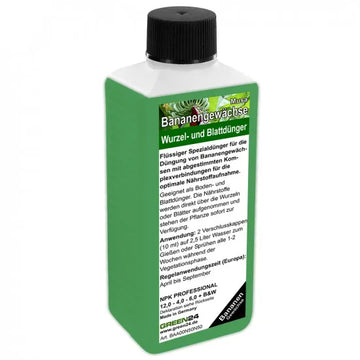
For banana-family plants in Musa and Ensete. Dilute the liquid concentrate with water for root or foliar application.
For active growth, regularly April–September. The plant is growing, the root ball is moist and water can drain.
Use reduced strength for young and newly planted specimens. Count nutrients in fresh compost; investigate a soft pseudostem or uncertain root condition before feeding.
Application in one place
Enter your water volume or use the height and foliage width of one banana plant for a rough root-watering guide. Quarter- and half-strength settings are available for young and newly planted plants.
1 capful = 5 ml. Use a suitable measuring aid for smaller partial amounts.
Enter a water amount from 0.1 to 1,000 litres.
A rough guide only for root-watering one banana plant, not for foliar spraying. Measure height from soil level and the width of the foliage crown. Pot volume, root-ball moisture, rooting, weather and location also matter. Use only when watering is needed; do not force the full guide amount and avoid standing water.
General GREEN24 guide: height (m) × width (m) × 3–4 litres. Centimetres are converted to metres. Concentrate volume follows this fertiliser’s dilution and the chosen stage. The guide does not measure an individual plant’s water needs.
Use a clean watering can or sprayer; preferably low-lime water or rainwater at 15–25 °C.
Enter the water volume and choose the appropriate dose stage. The size guide replaces neither assessment of plant development nor checking root-ball moisture.
Start by filling the container with part of the chosen water volume.
Shake the bottle. 1 capful = 5 ml; use a measuring aid for smaller partial amounts.
Add the calculated amount of concentrate to the water.
Top up to the chosen water volume and mix well. Watering or spraying: see below.
When to feed? Apply every 1–2 weeks during active growth, normally April to September. Between feeds, water as needed. Account for nutrients already in the growing medium and previous applications; do not continue feeding by the calendar alone when growth has paused.
Moisten the root zone first, then distribute the mixture evenly. Excess water must be able to drain from the container. Check root-ball moisture and root development; do not feed into a dry or waterlogged root ball.
Lightly wet the leaves in the morning, evening or overcast conditions, avoiding open flowers. Root and foliar feeding count towards the same feeding schedule, not two parallel programmes.
Net mass: 295 g for 250 ml; 1180 g for 1 litre.
The dilution is the same for both pack sizes.
| Pack size | Price |
|---|---|
| 250 ml | €11,95 EUR |
| 500 ml – twin pack (2 × 250 ml) | €18,95 EUR |
| 1 litre | €29,95 EUR |
Declared nutrient percentages. Product pH: 6.8.
Pre-fertilised soil and fertiliser already in the root ball contribute to the nutrient supply. Each of the four care products listed below can be mixed with our liquid fertiliser. When applying them together, follow both products’ specific instructions; conflicting or stricter directions take precedence. Do not mix undiluted concentrates.
Our Banana Fertiliser is mixable separately with Schädlings-Frei Organic, Trauermückenfrei Organic, KIRON Milben-Ex or Rosen Pilz-Frei BOCCACIO. This confirmation covers the fertiliser plus one of these products at a time. Follow the specific directions and stricter conditions of both products.
Request the compatibility table →Beyond NPK · understand the formulation
Water-soluble nutrients and coordinated formulation properties make feeding your banana plant straightforward. Discover what the prepared mixture provides for leaves and roots.
All nutrients are water-soluble. In the fully diluted mixture, they are available for feeding through roots and leaves.
Copper, iron, manganese and zinc are declared as EDTA chelates. This binding helps keep these trace nutrients available in solution.
The buffer system helps regulate the pH of the finished watering or spraying solution. The source water also influences the resulting value.
Good wetting and adherence help distribute the spray solution across the leaves. Dissolved nutrients are then available at the leaf surface for uptake.
The formulation helps reduce adverse hard-water effects and deposits on the leaves. Low-lime water or rainwater provides a good starting point.
High plant compatibility when applied appropriately supports new banana-leaf development. Young and newly planted specimens receive a reduced strength; leaf size alone does not determine the stage.
Suitable nutrition supports leaf development and green foliage. Leaf finish means an even, well-kept appearance, not a sprayed-on shine. Broad banana leaves still rely on sufficient light and healthy roots; more fertiliser will not repair wind tears.
Chelation binds metal ions and can reduce undesirable hardness effects; it does not remove calcium or magnesium from the water. The product pH of 6.8 describes the concentrate. The prepared mixture also depends on the source water; no fixed target pH is promised.
Use clean, suitable watering or spraying equipment. Measure the water and calculated concentrate quantity carefully.


A touch of tropical foliage
A rolled leaf rises from the centre and opens into a broad green surface. This visible development makes banana plants distinctive in containers and summer gardens.
The concentrate supplements mineral nutrition during active growth. Warmth, light, even root-ball moisture and enough root space matter just as much. Visible leaf development helps you assess your care routine.
The ribbed leaves use light to make sugars for plant growth. Wind can split the blades along their veins; these tears do not automatically indicate a nutrient deficiency.
Flowering depends on species, maturity and growing conditions. There is no reliable shared flowering month in Central Europe. Fertiliser cannot replace missing warmth or light.
Edible cultivars need sustained warm, bright conditions for fruit development. Musa basjoo is mainly grown for its foliage here. A regular outdoor harvest should not be expected in Central Europe.
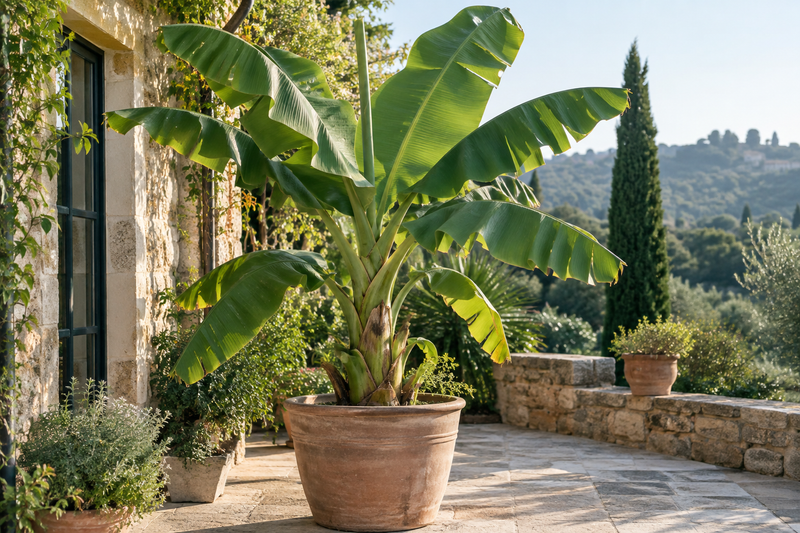
A spacious container in a warm, bright, wind-sheltered spot gives the broad leaves room to stand out. Plan space around the plant and species-appropriate overwintering from the start.
From the root zone to fresh shoots
Large leaves use light to make sugars. Roots absorb water and mineral nutrients. Overlapping leaf sheaths form the pseudostem, whose tissues connect the plant parts. Flowering and fruiting are possible later stages, not a target every garden banana reaches.
Absorbing roots need moisture and oxygen. The pot and growing medium limit root space. Musa can develop rooted suckers at its base; their water and nutrient needs form part of the whole plant.
A new leaf unfurls from the centre. The blades provide sugars through photosynthesis for further growth. Nitrogen contributes to proteins and chlorophyll. A large foliage crown still needs suitable warmth, light and healthy roots.
The firm pseudostem supports the foliage crown; vascular tissue connects the plant parts. In Musa, the flowering and fruiting pseudostem dies afterwards, while suckers can continue growing. Do not routinely top healthy main shoots.
Nitrogen supports chlorophyll and protein formation. Phosphorus contributes to energy transfer, while potassium supports water regulation and transport. The formulation supplements these minerals and declared micronutrients; it cannot replace suitable light and root conditions.
Understanding plant feeding
The diluted mixture reaches roots in soil or containers during watering. Foliar application is also possible. Explore what happens from first contact to use within the tissues.
Select a point in the picture or choose a stage.
Stage 01 / 04
The mixture reaches the soil around fine roots. Dissolved nutrients are available at the interface between roots and soil.
Good to knowAlways dilute the concentrate and keep to the stated dosage.
Watering carries dissolved nutrients into the growing medium around the roots. Contact with the absorbing root surfaces is the first step.
Stage 02 / 04
Fine root hairs increase contact with the growing medium. Tiny transport proteins in the membranes surrounding root cells help dissolved nutrients enter the cells.
Good to knowRoots take up nutrients; they do not simply absorb all the fertiliser along with the water.
Root hairs increase the contact area. Transport proteins in cell membranes enable mineral ions to enter; water movement and nutrient uptake are distinct processes.
Stage 03 / 04
In the roots of your banana plant, cell membranes and their transport proteins regulate the uptake of dissolved nutrients. Substances do not simply flow unfiltered into the plant with the irrigation water.
Good to knowMore fertiliser does not automatically mean better nutrition.
Between contact with the root surface and onward transport, controlled processes take place within the root tissues. Transport across cell membranes helps the banana plant take up nutrients; water movement and nutrient uptake are distinct processes.
Stage 04 / 04
Inside the root are fine transport channels called xylem. Water and absorbed nutrients can travel through them towards shoots and leaves.
Good to knowHealthy roots and suitable growing conditions are important for nutrient supply.
After entering the vascular tissue, nutrients can travel with the water stream in the xylem towards the shoot. Uptake and nutrient supply also depend on root health and growing conditions.
Stage 01 / 04
The fully diluted mixture wets the leaf surface. Avoid open flowers and spray only under suitable application conditions.
Good to knowBanana Fertiliser is also suitable for foliar application. Use only the fully diluted mixture and count the application towards the feeding plan.
Foliar feeding places diluted nutrient solution on the leaf surface. Wetting depends on factors including the leaf surface and the solution.
Stage 02 / 04
The leaf surface protects the plant. Dissolved nutrients can pass through this layer; tiny openings in the leaf may also play a part. Uptake varies with the type of leaf and the conditions.
Good to knowDifferent leaves do not absorb a nutrient solution equally well.
Dissolved nutrients can pass through the protective cuticle; pathways involving stomata may also contribute. Their relative importance varies with plant species and conditions.
Stage 03 / 04
Behind the surface lies living leaf tissue. Its cells can take up nutrients that have crossed the surface and use them for their activities.
Good to knowA droplet on a leaf does not yet mean its nutrients have been absorbed.
After crossing the surface, nutrients can be taken up by living leaf cells. The amount depends on factors including the nutrient, formulation and environmental conditions.
Stage 04 / 04
The plant can use absorbed nutrients within the leaf. Some can also reach other plant parts. This depends on the nutrient and the plant's condition.
Good to knowFoliar feeding does not mean every nutrient immediately reaches the whole plant.
Absorbed nutrients can be used within the leaf. Whether and how far they move to other plant parts depends on the nutrient and the plant's condition.
Development influences requirements
Young and newly planted specimens receive one quarter to one half of the standard strength. After repotting, secure suitable moisture and drainage and count nutrients in the new compost. Even a vigorous sucker is newly planted after separation.
Feed at the stated interval during active growth. Watch new leaves unfurl and adjust watering to light, warmth and root-ball moisture. Do not increase the concentration on your own to obtain larger leaves or possible fruit development.
Do not continue feeding when growth is resting. Suitable overwintering depends on the banana species: warmth-loving dessert bananas are not interchangeable with protected garden-grown Musa basjoo. Cool quarters reduce water use; continue checking the root ball and leaf undersides.
Consider development, location and existing nutrients together. Plant height determines neither the dose stage nor individual water needs.
Application & calculator →Your growing conditions matter
Containers, summer borders and indoor spaces provide different conditions. Consider warmth, light, shelter from wind and root space together; dilution remains product-specific while water volume follows actual need.
Choose a spacious container with free drainage in a warm, bright, wind-sheltered position. Large leaves may use much water on warm days, but still check the root ball before watering. Avoid standing water in the saucer.
Bananas bring tropical foliage to summer borders. Hardiness is species-dependent: with suitable protection, Musa basjoo may regrow from underground parts even if leaves and the pseudostem freeze. Do not transfer that trait to other Musa or Ensete.
Identify the banana species before choosing winter accommodation. Keep warmth-loving dessert bananas frost-free, provide sufficient light and check watering needs at the root ball. Inspect leaf undersides for spider mites and mealybugs before moving indoors; a warm room does not by itself justify winter feeding.
At the start of growth, check root space and growing medium. Repot only when needed into a suitable container with drainage, retaining the existing planting depth. Count nutrients in fresh compost when planning later feeds; a reduced strength does not mean an immediate extra feed is needed.
Banana and strelitzia compost or the banana repotting set support your next pot change. Choose according to the root space needed and account for existing nutrients.

A matching growing medium for the next repotting. Allow for the nutrients already included when planning further feeding.

10 litres of banana and strelitzia compost plus 250 ml of this concentrate. The set is an alternative to separate purchases; account for supplies you already have.
Understand plant care problems
Split leaves, brown margins and stalled growth call for different responses. Check wind exposure, light, warmth, root-ball moisture and roots. In winter quarters, also inspect leaf undersides for spider mites and mealybugs.
Inspect leaf undersides indoors and separate affected plants.
Soft wet tissue and weak growth call for a root and drainage check.
Wind often splits leaves lengthwise; brown leaves after frost do not establish nutrient deficiency.
These details help assess growing conditions, root problems or a possible infestation:
Leaf colour alone identifies neither a nutrient deficiency nor the amount of feed needed. Targeted soil or leaf analysis may help with unclear damage. Identify the cause before choosing a plant-protection treatment.
These four care products are each separately mixable with our liquid banana fertiliser.
Dr. Stähler
€16,95
Insect control: check the pest, plant species and authorised application site.
Mixable with GREEN24 liquid fertilisersView product & applicationDr. Stähler
€9,99
For fungus gnat larvae: follow the authorised crop and watering application.
Mixable with GREEN24 liquid fertilisersView product & applicationDr. Stähler
€12,95
Mite control: identify the infestation and follow the authorised application.
Mixable with GREEN24 liquid fertilisersView product & applicationDr. Stähler
€13,95
Fungal control: check the disease, plant species and authorised growing situation.
Mixable with GREEN24 liquid fertilisersView product & applicationMixability applies to fertiliser plus one product at a time, not to all products mixed together. Follow crop, pest, application site, dose, waiting periods and the stricter requirements of both sets of instructions. Do not mix undiluted concentrates.
Use plant protection products safely. Always read the label and product information before use.
For banana-family plants in Musa and Ensete. Dilute the liquid concentrate with water for root or foliar application.
Dilution: 10 ml per 2.5 l of water. Use only one quarter to one half strength for young and newly planted plants.
Measure out the concentrate and mix it with the stated amount of water. Never apply undiluted.
Calculated at the stated standard dilution; the amount needed per application depends on the plant and growing conditions.
Do not apply in sunlight, below 5 °C or above 30 °C. Never apply the concentrate undiluted.
SDS – Safety data sheet available on request.
Avoid contact with eyes, skin and clothing. Do not inhale spray mist. Wear protective clothing, rubber gloves and safety glasses when handling the product. Keep away from food and beverages. Wash your face and hands thoroughly after use. Official advisory recommendations take precedence. Fertilisers may leave permanent stains on surfaces. Do not allow fertiliser to enter bodies of water or wastewater.
Official advisory recommendations take precedence.
Wash your face and hands thoroughly. Use diluted fertiliser promptly and keep it out of water bodies and wastewater.
Store in a dry, dark place above +8 °C and no higher than +38 °C. Keep out of reach of children and animals.
Keep tightly closed in the original container, separate from food and animal feed.
Avoid large temperature fluctuations. Temperature-related discolouration or crystals may occur; the crystals dissolve by the dilution stage at the latest and do not impair product quality. For this fertiliser, store dry and dark above 8 °C and at no more than 38 °C. Use diluted fertiliser promptly.
Do not allow fertiliser residues or rinsing water to enter waterways or wastewater. Follow the disposal instructions on the packaging.
Measure concentrate accurately and apply only after dilution. More fertiliser does not compensate for insufficient light, drought or damaged roots.
The original leaflet explains safe mixing and application. Use this banana concentrate’s own dilution; young and newly planted plants receive one quarter to one half of the standard strength.
More products to compare and discover.

Compare within the range: Olive Tree Fertiliser.

Compare within the range: Hedychium fertiliser.


