


Schädlings-Frei-Organic
€16,95
For spraying or watering, depending on the authorised use. The method depends on the plant, pest and location.
View product in our shop →

Inspect the root ball, compost and water uptake. Allow only the additional root space actually needed.
Choose a stable pot with clear drainage holes. Consider mature plant size and the available space.
Prepare a clean surface and tools, and loosen the compost. Keep drainage holes open; a thick gravel layer is not a universal requirement.
Gently release the root ball from its old container. First assess persistent wetness, odour and damaged roots.
Gently loosen loose outer compost and remove dead parts selectively. Do not heavily prune healthy roots without a reason.
Set planting depth and any graft union according to the particular rose, rather than using only the pot rim as a guide.
Water in thoroughly, check drainage and monitor moisture in the original root ball over the following days.
Begin supplementary feeding no earlier than four weeks after repotting during active growth. Account for the initial nutrients in the compost and the actual needs of the plant.
5 ml per 2.5 litres of water
5 ml equals one capful. Every 1–2 weeks from April to September during active growth.
| Water | Standard 100 % | Young plants 50 % | Seedlings with leaves 20 % |
|---|---|---|---|
| 1 l | 2 ml | 1 ml | 0.4 ml |
| 5 l | 10 ml | 5 ml | 2 ml |
| 10 l | 20 ml | 10 ml | 4 ml |
Shake the concentrate before use.
Pour the required amount of water into a suitable container.
Use standard 100%, young plants 50%, or seedlings with leaves 20% of the basic dilution. Concentration does not determine the watering volume needed.
Measure the calculated amount accurately with a suitable measuring aid.
Add the concentrate to the water and mix evenly.
Apply the solution to the pre-moistened root zone or spray the foliage as needed. Avoid open flowers.
Do not mix the entire bottle into the compost bag. Dilute the concentrate separately with water.
10 litres of ready-to-use rose compost and 250 ml NPK liquid fertiliser for later feeding. Repot your rooted container rose into fresh compost and measure subsequent nutrients separately.
Begin supplementary feeding no earlier than four weeks after repotting during active growth. Account for the initial nutrients in the compost and the actual needs of the plant.
NPK fertiliser solution 6.5 + 8.0 + 9.0 with trace nutrients
EC FERTILISER. Declared mass percentages; pH 6.2.
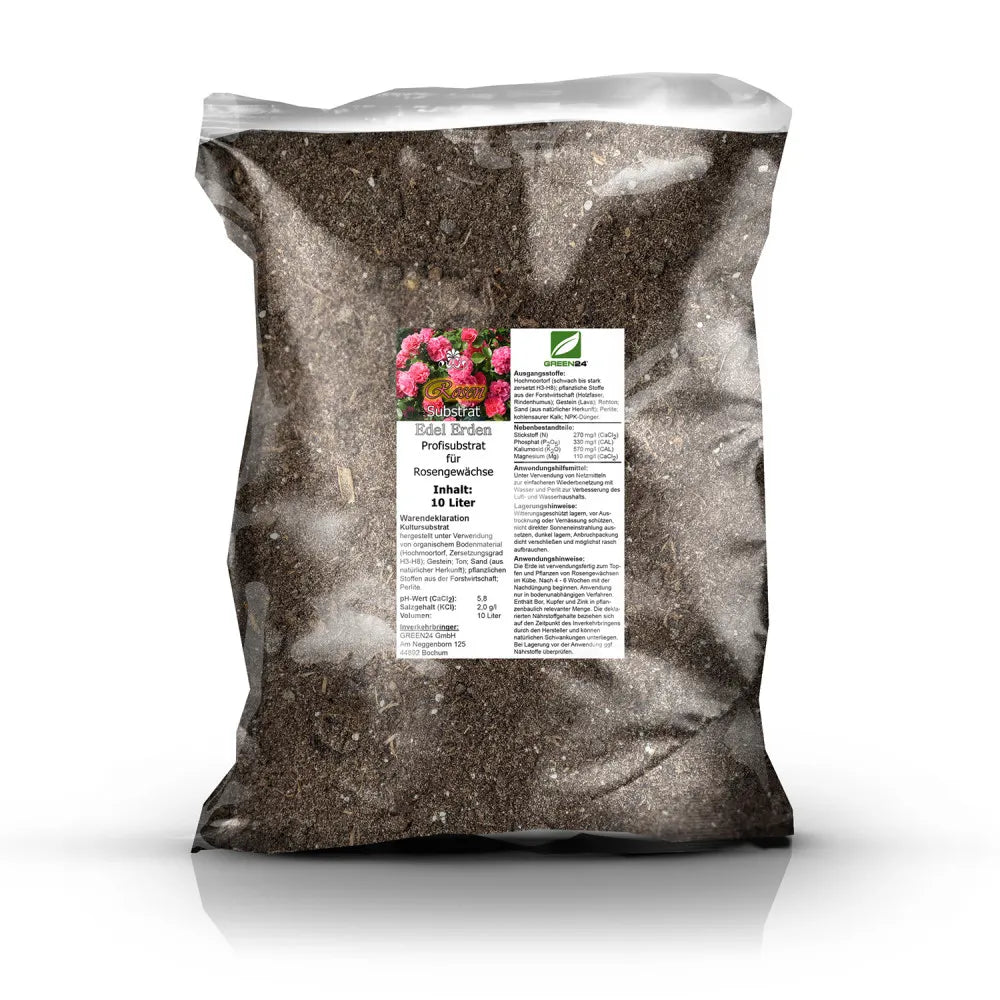
Ingredients declared on the bag.
Raised-bog peat H3–H8; forestry-derived plant materials (wood fibre, bark humus); rock (lava); raw clay; sand; perlite; calcium carbonate; NPK fertiliser.
With wetting agents for rewetting and perlite for air and water balance.
pH, salt content and nutrients.
Values apply when placed on the market. Nutrient contents may change during storage; check stored compost before use where necessary.
Included: one 10-litre bag of compost and one 250 ml bottle of fertiliser. Plant and pot are not included.
After 4–6 weeks assess supplementary feeding according to the label and plant requirements; account for initial nutrients.
Begin supplementary feeding no earlier than four weeks after repotting during active growth. Account for the initial nutrients in the compost and the actual needs of the plant.
These steps apply to rooted container roses. Bare-root stock and graft-union position require the particular rose’s planting instructions.
For horticultural use. Suitable for root and foliar feeding.
Dry and dark
Store above 8 °C and at no more than 38 °C.
Keep out of reach of children and animals.
Minimise dust and avoid eye contact. Clean hands after handling. Keep compost away from food and animal feed.
Sheltered and tightly sealed.
Store sheltered from weather, in the dark and away from direct sunlight. Protect from drying and waterlogging; seal opened packs tightly and use promptly.
GREEN24 GmbH
Am Neggenborn 125
44892 Bochum
Germany
Original set image Opens in a new window.
Original compost label Opens in a new window.
One 10-litre bag of compost and one 250 ml bottle of fertiliser. Plant and container are not included.
Begin supplementary feeding no earlier than four weeks after repotting during active growth. Account for the initial nutrients in the compost and the actual needs of the plant.
5 ml per 2.5 litres of water. Standard 100%, young plants 50%, seedlings with leaves 20%.
At standard dilution, the 250 ml bottle makes 125 litres of watering or spray solution. Match the amount of water to the plant’s needs.
No. Use the ready-to-use compost and dilute the concentrate separately with water for later feeding.
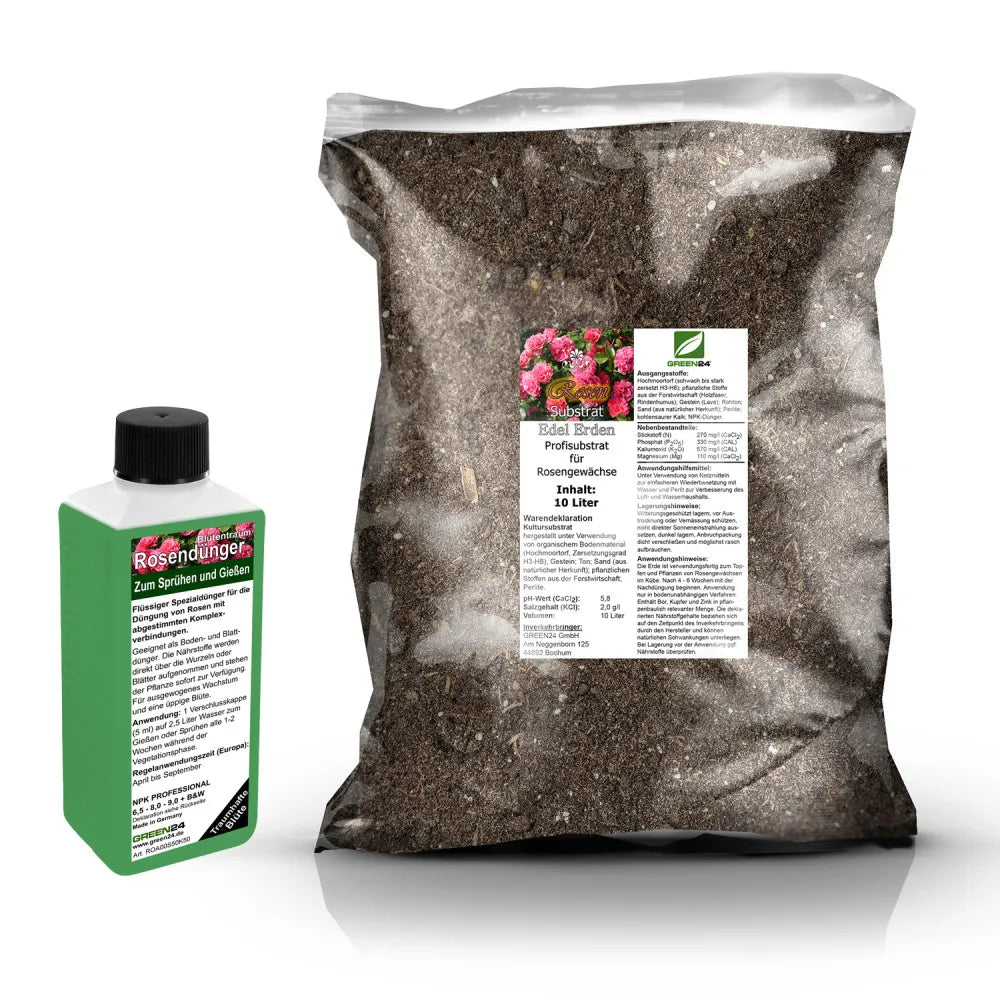
10 litres of ready-to-use rose compost and 250 ml NPK liquid fertiliser for later feeding. Repot your rooted container rose into fresh compost and measure subsequent nutrients separately.
Begin supplementary feeding no earlier than four weeks after repotting during active growth. Account for the initial nutrients in the compost and the actual needs of the plant.
5 ml per 2.5 litres of water. For later feeding during active growth.
The plant species, photographs and details of location, moisture and previous care help assess plant damage. Identify the cause and a suitable application before treatment.
More fertiliser is not a general solution to growing problems. A recommendation to buy products together does not confirm that they can be mixed.
General manufacturer information: these products have not been selected here as suitable treatments for the plant shown here. Before use, check the plant species, pest, application site and current instructions.


Use plant protection products safely. Always read the label and product information before use.
Selected additions for your plant care.


